Friday, March 27, 2026
Skills-Based Hiring: A Practical Guide to Hiring for Ability

Skills-based hiring means evaluating candidates on whether they can demonstrate the skills a role actually needs, instead of filtering on degrees, job titles or keyword matches. You define the skills for each role up front, then design every stage of the process to collect evidence of them. The result is a wider, fairer talent pool and hiring decisions you can explain.
This guide covers what skills-based hiring is, why traditional filters miss good people, how to define and assess skills for a role, and a practical rollout plan.
What is skills-based hiring?
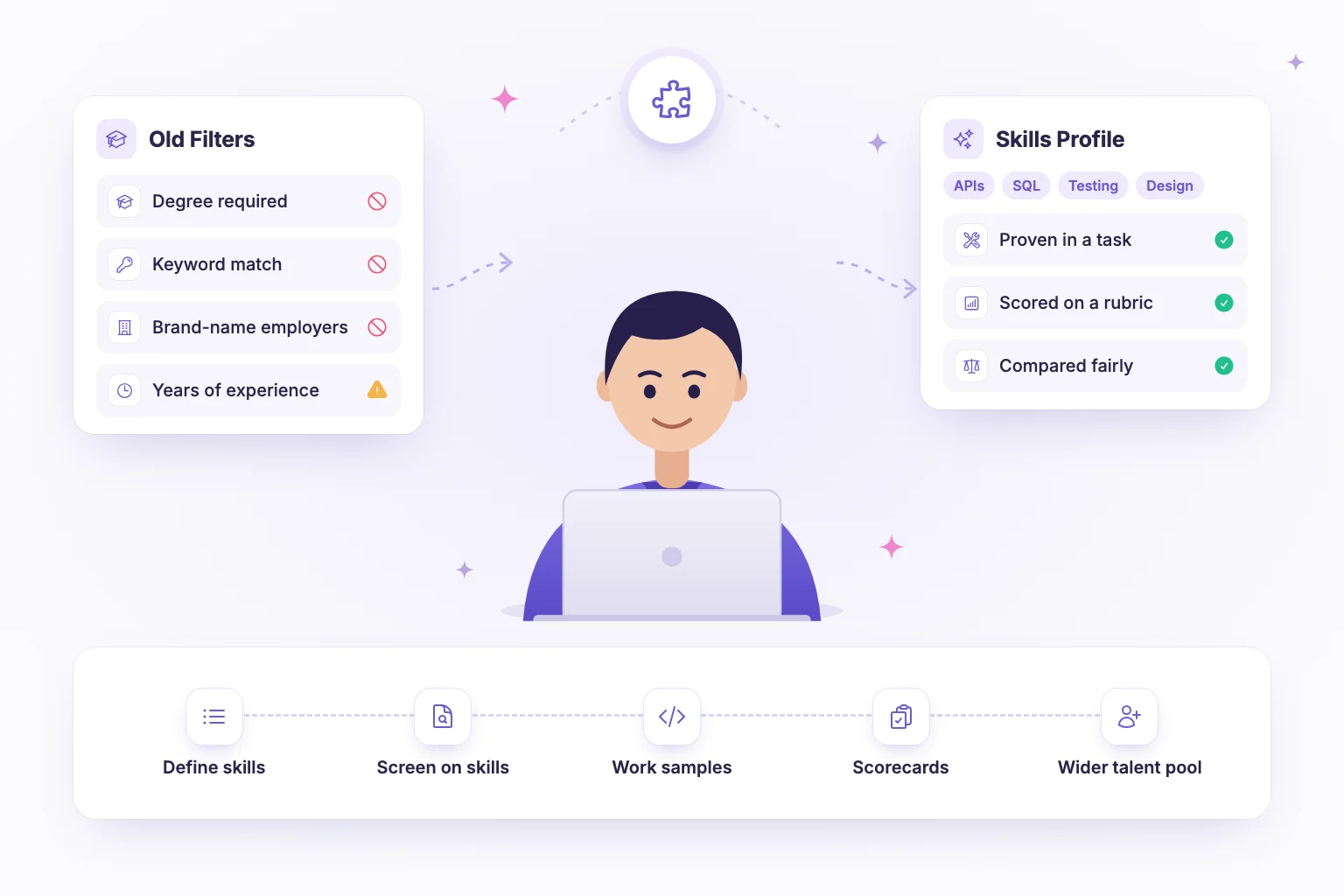
Traditional hiring uses proxies. A computer science degree stands in for programming ability. Five years at a known company stands in for seniority. A keyword match on a resume stands in for relevant experience. Proxies are convenient, but they are only loosely connected to what someone can do on the job.
Skills-first hiring replaces proxies with direct evidence. For each role you ask two questions:
- What does someone need to be able to do to succeed here?
- How will we see them do it, or something close to it, before we hire them?
Degrees and experience still count, but as one form of evidence among several, not as a gate.
Why degree and keyword filters miss talent
Filters based on credentials and keywords fail in predictable ways:
- They exclude non-traditional paths. Self-taught developers, bootcamp graduates, career changers and people who learned on the job are screened out before anyone looks at their work.
- They reward resume writing, not ability. Candidates who know which keywords to include get through. Candidates who describe their work plainly do not.
- They over-weight tenure. Years of experience measure time, not growth. Two people with five years can have very different skill levels.
- They reinforce existing bias. Preferences for particular schools or employers tend to narrow the pool along socioeconomic and demographic lines.
- They produce false positives too. A resume full of the right terms can belong to someone who used a tool once, years ago.
The cost is not only missed candidates. Mis-hires are expensive: the U.S. Department of Labor estimates a bad hire can cost at least 30% of the employee's first-year earnings. Evaluating the right things reduces that risk.
How to define skills for a role
A skills profile is a short document, agreed between the hiring manager and recruiter before the role opens. Keep it to one page.
Step 1: Start from outcomes
List the three to five things the person must deliver in their first year. For a data analyst this might be "build the weekly revenue dashboard" and "answer ad hoc questions from the sales team within a day".
Step 2: Derive the skills behind each outcome
For each outcome, ask what skills it requires. The dashboard needs SQL querying, data modelling and visualisation. Answering sales questions needs stakeholder communication and prioritisation.
Step 3: Separate must-have from trainable
Some skills must be present on day one. Others can be learned in the first few months. Only screen on must-haves.
Step 4: Set a proficiency level
Describe what "good enough" looks like for this level. "Writes correct joins and aggregations on unfamiliar schemas" is more useful than "strong SQL".
Example skills rubric: mid-level backend engineer
| Skill | Type | Expected proficiency | How we assess it |
|---|---|---|---|
| API design | Must-have | Designs clear, versioned REST endpoints with sensible error handling | Practical task + interview |
| Data modelling | Must-have | Normalises schemas and explains indexing trade-offs | Open-ended question + interview |
| Writing tested code | Must-have | Writes working code that passes provided and hidden test cases | Coding exercise with test cases |
| Debugging | Must-have | Isolates a failing component methodically | Debugging task |
| Written communication | Must-have | Explains a technical decision clearly to a non-specialist | Open-ended written answer |
| Specific cloud provider | Trainable | Not required at hire | Not screened |
Notice that the rubric never mentions degrees or years. Each skill maps to a way of seeing it.
How to assess skills
Match each skill to the assessment method that shows it most directly. Our overview of assessment question types that predict job performance goes deeper, but the short version is:
- Knowledge: short multiple-choice questions, auto-scored, useful as an early filter.
- Hands-on technical skill: practical coding or task-based exercises with clear pass criteria.
- Reasoning and written communication: open-ended written questions scored against a rubric.
- Verbal communication: recorded video responses, reviewed asynchronously.
- Collaboration and judgement: structured behavioural interviews scored on a shared scorecard.
Screening resumes for skills, not keywords
You still need to shortlist. Screen resumes against the must-have skills in the rubric, looking for evidence (projects, responsibilities, outcomes) rather than exact terms. A candidate who "built and maintained the payments API" shows API design even without the words "REST" or "microservices".
Keep assessments proportionate
Skills-based does not mean long. A focused 45 to 90 minute assessment covering the must-haves is usually enough. Tell candidates what to expect, how long it takes and which resources are allowed.
Score with structure
Evidence only helps if everyone reads it the same way. Use a scorecard with behavioural anchors for each skill so a "3" means the same to every reviewer. Our guide to building an interview scorecard includes a sample template.
A rollout plan for skills-first hiring
Changing how an organisation hires works best in stages.
- Pick one or two pilot roles. Choose roles you hire often, with engaged hiring managers.
- Write the skills profile and rubric using the steps above.
- Rewrite the job description around outcomes and skills. Mark degrees as optional where they are not required.
- Build the assessment so each must-have skill is tested at least once.
- Train interviewers on the scorecard and run a calibration session using sample answers.
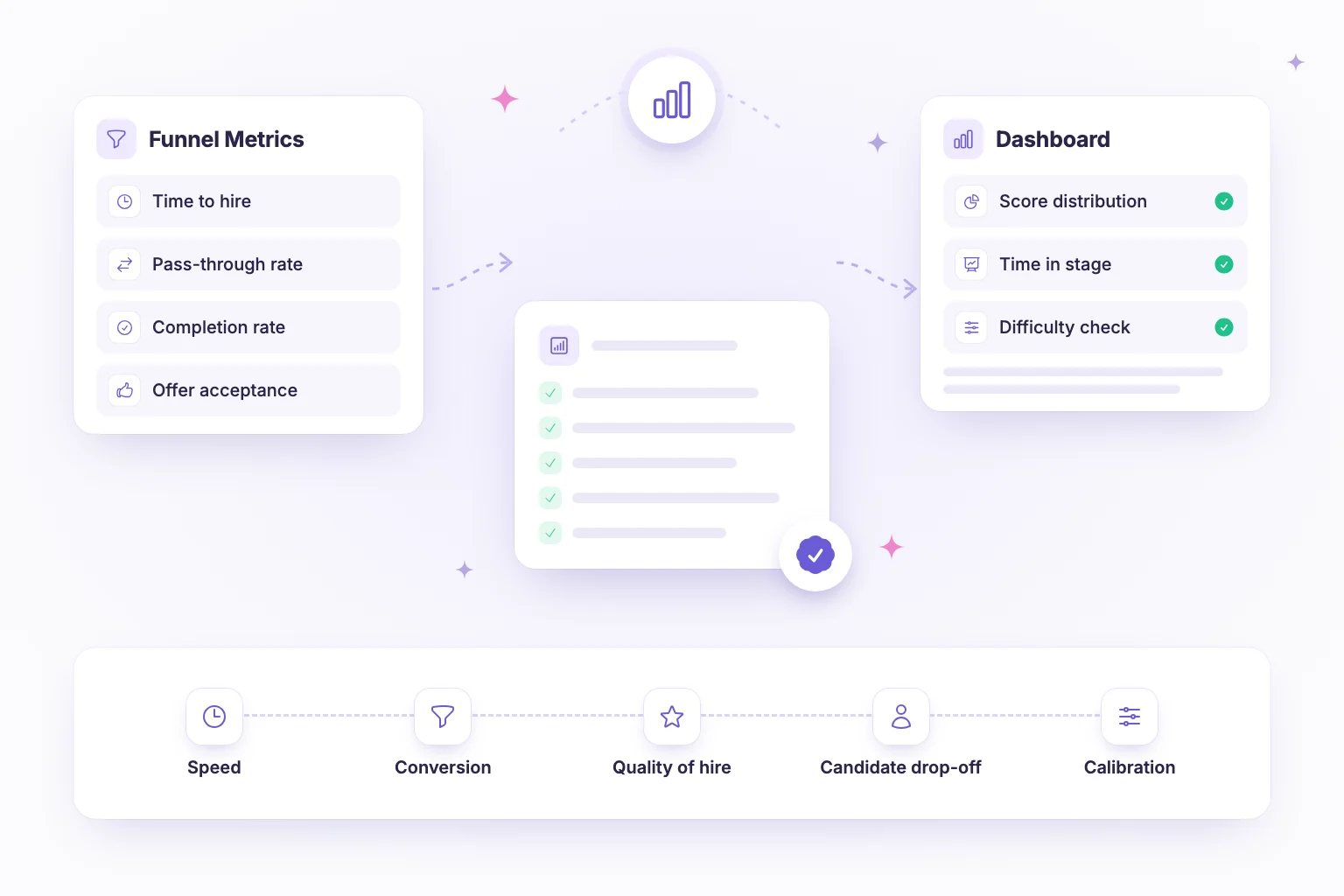
- Run the pilot for a hiring cycle and track completion rates, pass rates by stage, time to hire and hiring manager satisfaction.
- Review and adjust. Remove questions that do not separate strong from weak candidates, then extend to the next role family.
How to measure whether skills-based hiring is working
Decide on a handful of measures before the pilot starts, so you can compare against how the same role was hired previously:
- Pool breadth: how many candidates reach the assessment stage who would previously have been filtered out by degree or tenure rules.
- Stage pass rates: whether the assessment separates candidates clearly, or whether almost everyone passes or fails.
- Assessment completion rate: a sharp drop suggests the test is too long or poorly explained.
- Interview-to-offer ratio: if skills screening works, fewer interviews should be needed per offer.
- Early performance: hiring manager ratings at three and six months, compared against assessment scores.
None of these needs a data team. A simple review after each hiring cycle, looking at where candidates drop out and whether the people you hired are succeeding, is enough to show whether the approach is paying off and which parts to adjust.
Common pitfalls
- Relabelling without changing. Removing "degree required" from the ad while recruiters still filter on it achieves nothing.
- Too many skills. A profile with fifteen must-haves is a wish list. Keep it to four to six.
- Unvalidated tests. Review question performance after each cycle and retire weak items.
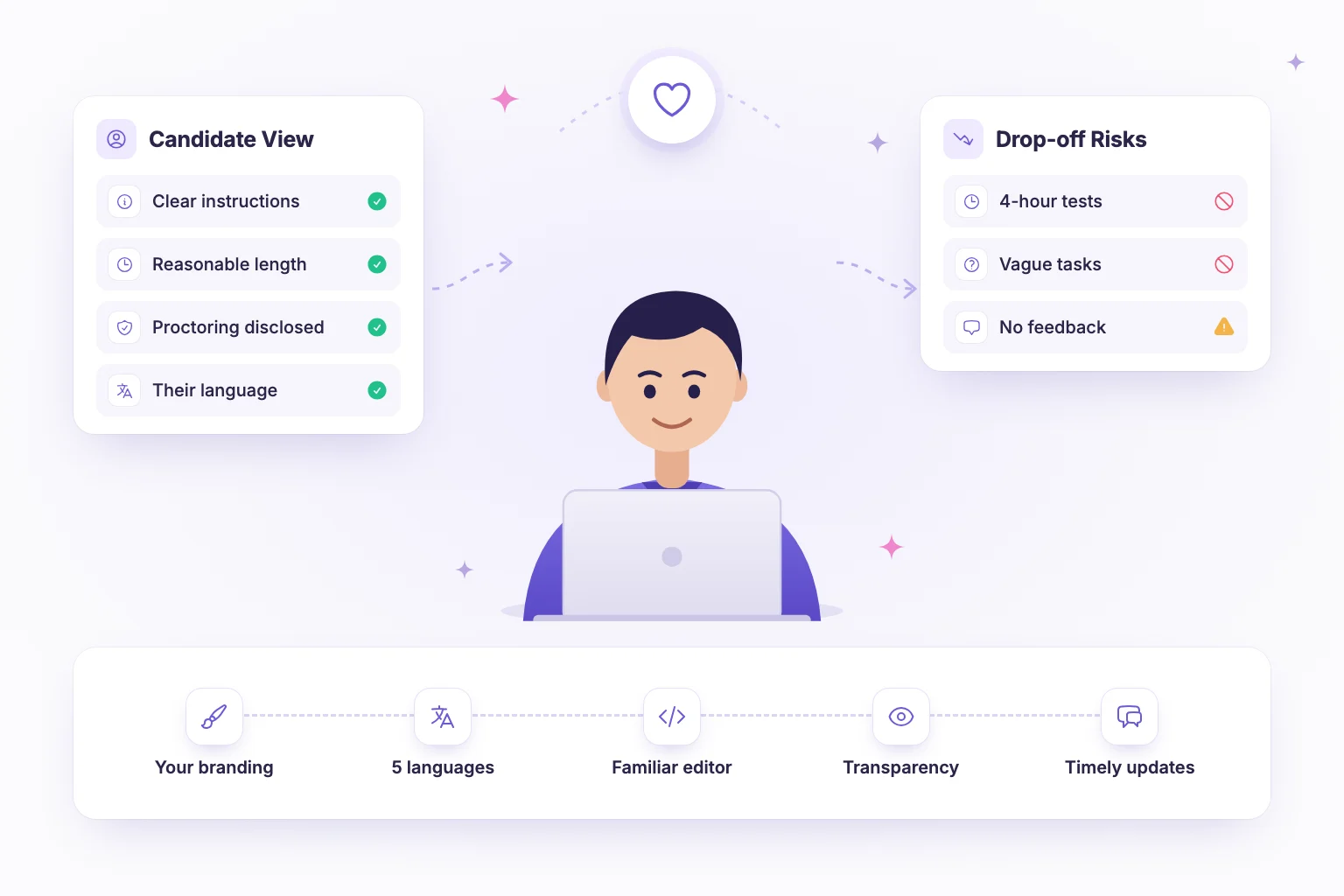
- Ignoring candidate experience. Long, unexplained tests cause drop-off, especially among strong candidates with options.
How NirnAI supports skills-based hiring
NirnAI is designed around skills evidence at every stage. AI resume screening ranks resumes against a screening rubric of the skills the role needs, so shortlisting focuses on evidence of ability rather than keyword matches or credentials.
For assessments, AI question generation reads your job description, extracts the skills and seniority, and drafts role-specific questions for you to review and edit before publishing. You can mix all four assessment question types: auto-scored multiple choice, in-browser coding with test cases in nine languages, open-ended written answers and recorded video responses, so each skill in your rubric is tested with the right method.
Structured scorecard templates keep every reviewer rating the same skills on the same scale, and analytics show score distributions, section-level breakdowns and difficulty calibration so you can see which questions actually separate candidates. Visual workflows then auto-advance candidates who meet the bar.
Want to pilot skills-first hiring on your next role? Start a 14-day free trial and build your first skills rubric and assessment in an afternoon.
Frequently asked questions
- What is skills-based hiring?
- Skills-based hiring is an approach where candidates are evaluated on whether they can demonstrate the specific skills a role requires, rather than on proxies like degrees, previous job titles, employer brands or years of experience. The skills are defined up front for each role, and every stage of the process, from resume screening to interviews, is designed to collect evidence of those skills.
- Does skills-based hiring mean removing degree requirements?
- Usually it means making degrees optional rather than banning them. Where a qualification is legally or professionally required, such as a licence, keep it as a knockout criterion. For most other roles, treat a degree as one possible source of evidence for a skill, alongside work history, projects, certifications and assessment results. The point is to stop rejecting capable people who learned the skill another way.
- How do you assess skills during hiring?
- Match the assessment method to the skill. Knowledge can be checked with short multiple-choice questions. Hands-on technical skills are best tested with practical tasks such as coding exercises with test cases. Communication and reasoning suit open-ended written or recorded video answers. Collaboration and judgement are best explored in structured interviews scored against a shared scorecard with defined rating anchors.
- How long does it take to move to skills-based hiring?
- Most teams can pilot skills-based hiring on one or two roles within a few weeks: define the skills profile, build a rubric and assessment, and train interviewers on the scorecard. A wider rollout across departments takes longer because each role family needs its own skills profile and calibration. Starting small lets you fix problems before scaling the approach.