Wednesday, May 6, 2026
How to Reduce Time to Hire: 10 Bottlenecks and How to Fix Them

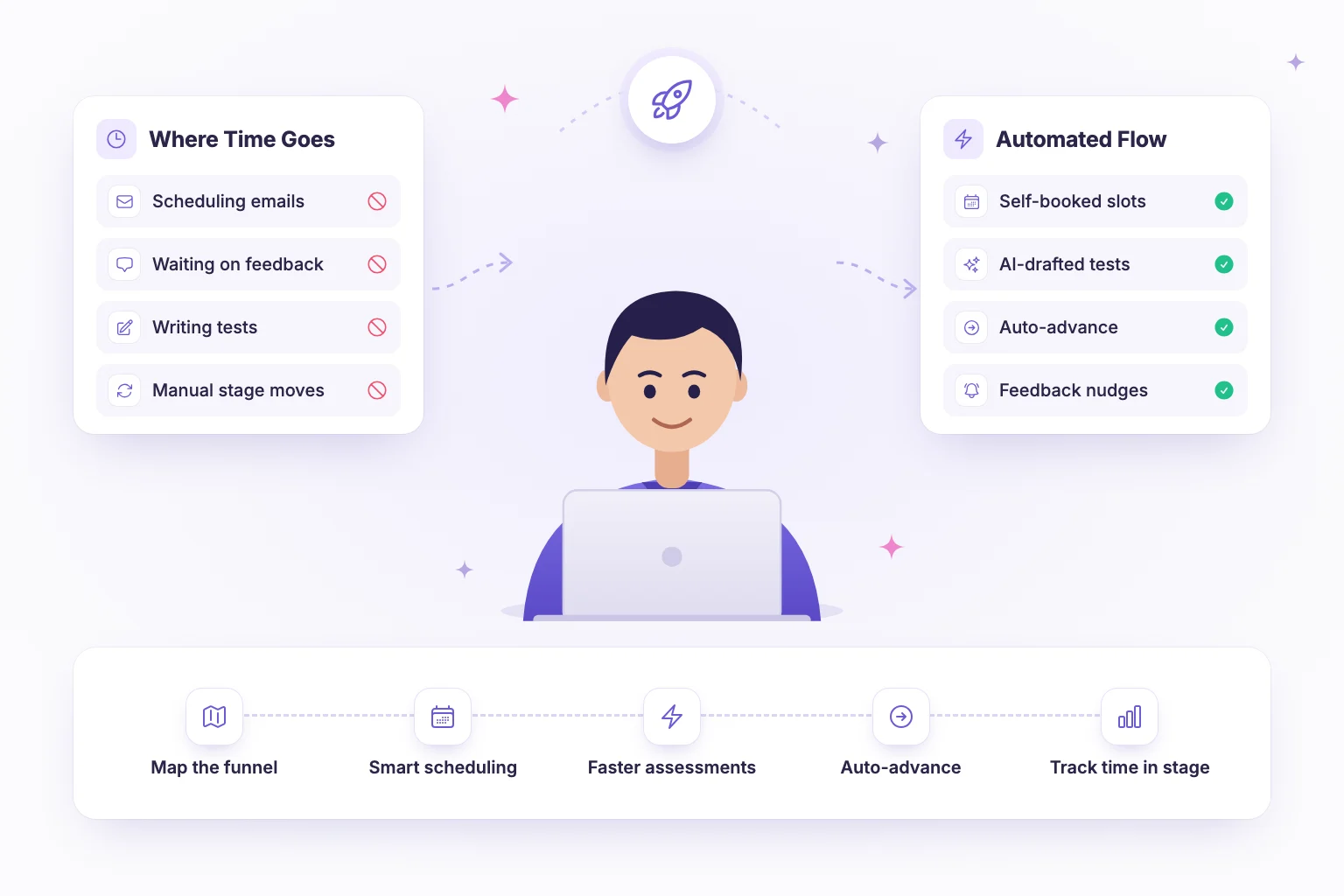
If you are wondering how to reduce time to hire, start here: measure how long candidates wait between stages, not just how long each stage takes, then remove that dead time with self-service scheduling, feedback deadlines and automatic stage moves. Most hiring processes are not slow because interviews are long; they are slow because candidates sit idle while someone books a call, writes feedback or updates a spreadsheet. Fix the handoffs and your time to hire drops without lowering the bar.
This guide shows you how to map where the time actually goes, walks through ten bottlenecks we see again and again, and ends with a table you can use to assign each fix to an owner.
Why time to hire matters
Strong candidates rarely run one process at a time. Every idle day is a day in which another employer can make an offer first, and many teams find that their best-scoring candidates are also the ones most likely to drop out of a slow process. A long process also costs your own team: hiring managers context-switch back into candidates they reviewed a week ago, interviewers forget details, and recruiters spend hours chasing updates.
There is a quality angle too. When a process drags, teams are tempted to cut the parts that feel slow, often the structured assessment, and rely on gut feel instead. That trade is expensive. The U.S. Department of Labor estimates a bad hire can cost at least 30% of the employee's first-year earnings. The goal is a faster process that keeps its evaluation rigour, which is why you should target waiting time first.
Map where the time goes before you fix anything
Before changing your process, collect a baseline. For your last 20 to 30 hires (or candidates who reached the final stage), record:
- Stage entry and exit dates for each stage: screening, assessment, first interview, technical interview, final interview, offer.
- Active time: how long the candidate or interviewer was actually doing something (taking the assessment, sitting the interview).
- Dead time: the gap between one stage ending and the next one starting.
Calculate the median for each. The pattern is almost always the same: active time is measured in hours, dead time is measured in days. A 45-minute interview that takes six days to schedule and three days to debrief is a nine-day stage. That dead time is where you will find most of your savings.
Questions to ask of your data
- Which single gap between stages is the longest?
- Does one hiring manager or team take much longer to leave feedback than others?
- How many days pass between a candidate finishing an assessment and someone reviewing it?
- At which stage do the most candidates withdraw?
How to reduce time to hire: 10 bottlenecks and fixes
1. Back-and-forth interview scheduling
Email ping-pong to find a slot can add several days per interview round. Fix: connect interviewer calendars and let candidates self-book from available slots. Offer at least five options across two or three days so candidates in different time zones have real choices.
2. Slow interviewer feedback
Feedback that arrives days after an interview blocks the next decision and gets vaguer with every passing hour. Fix: set a 24-hour feedback deadline, give interviewers a structured scorecard so writing feedback takes minutes, and make the recruiter responsible for chasing anything overdue. Our guide to structured interview scorecards covers how to build one.
3. Manual stage moves
If a recruiter has to notice that a candidate finished an assessment and then move them by hand, candidates wait until someone checks. Fix: define rules, for example "score above the threshold moves to interview booking", so candidates advance automatically the moment a condition is met.
4. Building assessments from scratch for every role
When a new role opens, teams often spend a week writing questions before a single candidate can be tested. Fix: generate a first draft of role-specific questions from the job description, have the hiring manager review and edit it, and keep a library of assessments you can clone for similar roles. See how teams go from job description to test in minutes.
5. Assessments that are too long
A three-hour test gets postponed to the weekend, or abandoned. Fix: keep the core assessment to roughly 45 to 90 minutes, test only the skills the role actually needs, and state the expected duration up front so candidates can plan.
6. Assessment results nobody reviews
Auto-scored sections are ready instantly, but open-ended answers and coding submissions can sit in a queue. Fix: assign a named reviewer per job, set a review deadline, and track the time from submission to evaluation as its own metric.
7. Resume screening backlogs
A popular role can attract hundreds of applications, and manual screening becomes the first queue. Fix: screen against a rubric of the skills the role needs, rank applicants against it, and send a short assessment early instead of relying on resume impressions. Our post on how to screen resumes faster goes deeper.
8. Too many interview rounds
Each extra round adds scheduling time plus a debrief. Often two rounds test the same thing. Fix: map every round to the specific competencies it assesses. If two rounds overlap, merge them. Many teams can cover what they need in an assessment plus two or three interviews.
9. Delayed debriefs and decisions
Waiting for the next weekly hiring meeting to discuss a finalist can add a week on its own. Fix: hold a 15-minute debrief within 48 hours of the final interview, with scorecards completed beforehand, and agree in advance who makes the final call.
10. Slow offer approvals
Offers stuck in approval chains lose candidates at the very last step. Fix: agree on the salary band and approvers when the role opens, not when the candidate is chosen, so the offer can go out the same day as the decision.
Bottleneck, fix and owner at a glance
Use this table to assign each improvement. A fix without an owner tends not to happen.
| Bottleneck | Fix | Owner |
|---|---|---|
| Interview scheduling back-and-forth | Calendar integration and candidate self-booking | Recruiting ops |
| Late interviewer feedback | 24-hour deadline plus structured scorecard | Hiring manager |
| Manual stage moves | Rule-based auto-advance between stages | Recruiter |
| Writing assessments from scratch | Generate from the job description, then review and clone | Hiring manager and recruiter |
| Overly long assessments | Cap at 45 to 90 minutes; test only core skills | Hiring manager |
| Unreviewed submissions | Named reviewer per job and review deadline | Engineering lead or reviewer |
| Resume screening backlog | Rubric-based screening and early assessment | Recruiter |
| Redundant interview rounds | Map rounds to competencies; merge overlaps | Hiring manager |
| Delayed debriefs | Debrief within 48 hours of final interview | Recruiter |
| Slow offer approvals | Pre-approve salary band when the role opens | HR or finance |
How to keep time to hire low over time
Fixing bottlenecks once is not enough; they creep back as teams grow and hiring managers change. A few habits keep a hiring pipeline fast:
- Review stage timings monthly. Look at median days in each stage and between stages, per role.
- Track time to evaluate separately. The gap between a candidate submitting and a reviewer scoring is easy to miss and easy to fix.
- Watch completion rates. A falling assessment completion rate often signals that a test is too long or unclear.
- Share a service level with hiring managers. For example: feedback within 24 hours, debrief within 48 hours, offer within one business day of the decision.
For a broader view of which numbers deserve attention, see our guide to recruiting metrics that matter.
How NirnAI helps reduce time to hire
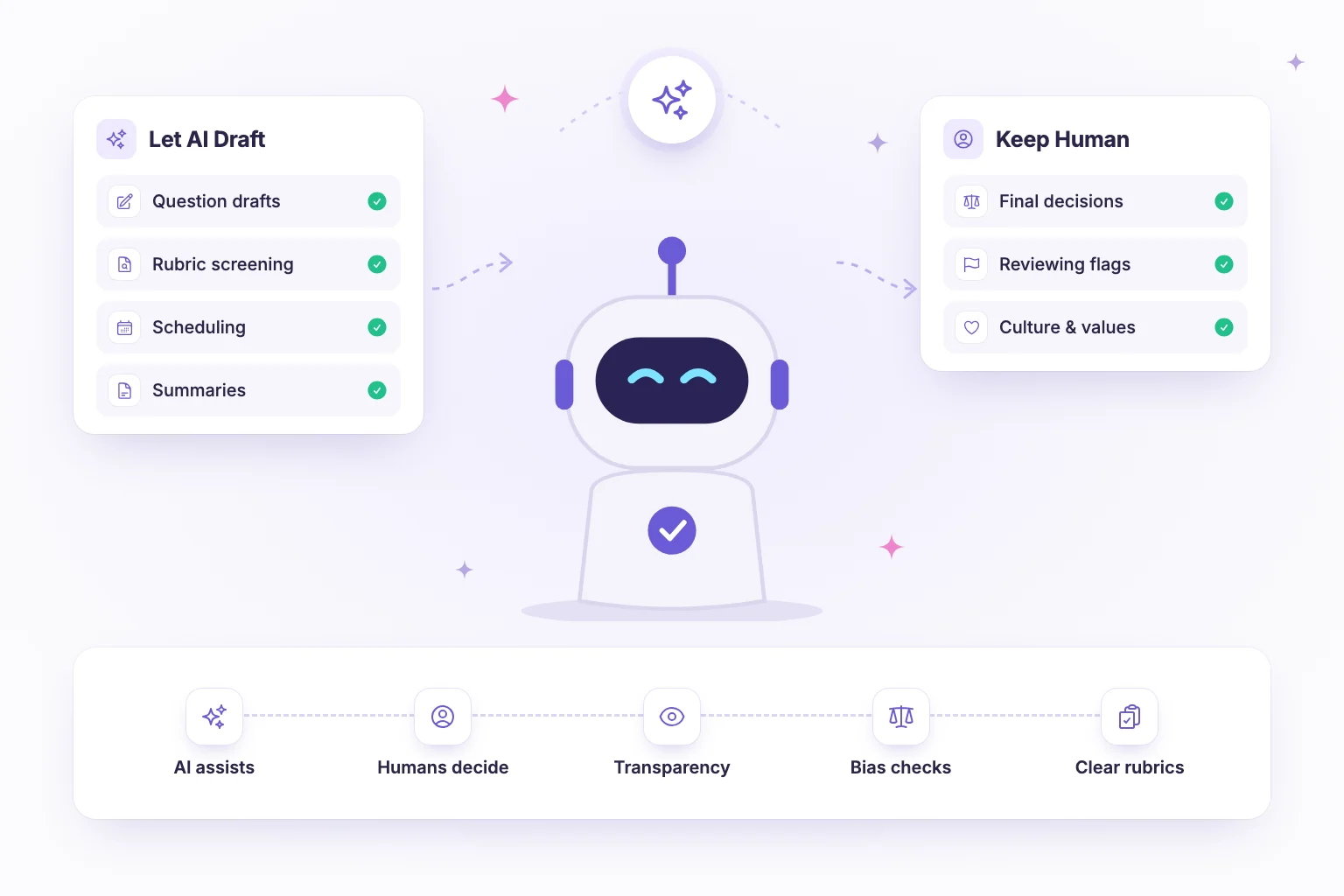
NirnAI is built to remove the dead time between stages while keeping evaluation structured.
- Visual hiring workflows: build your process in a drag-and-drop workflow builder with stages such as assessment and interview booking, branch on results, and let candidates auto-advance when they meet your criteria. A real-time Kanban pipeline shows where everyone is.
- Calendar self-booking: connect Google Calendar or Microsoft Outlook so candidates book available interview slots themselves, with auto-booking to cut the email back-and-forth.
- AI question generation: paste or upload a job description and NirnAI extracts the skills and seniority, then drafts role-specific MCQ, coding, open-ended and video questions for you to review and edit. Clone assessments for similar roles.
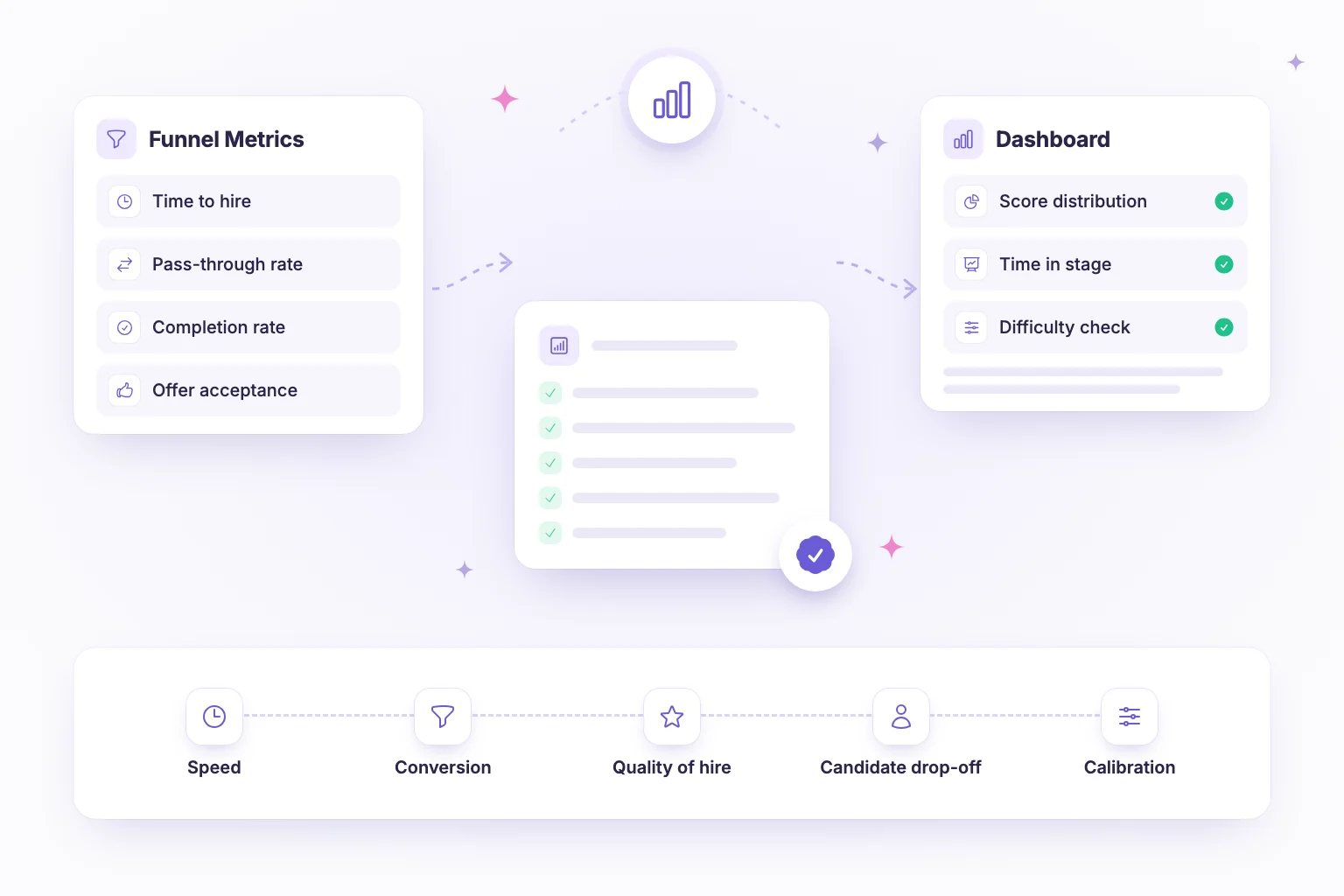
- Analytics: see time to attempt, complete and evaluate, completion rates and your pipeline funnel, so you know which stage is slowing you down.
- Structured scorecards: interviewers rate every candidate against the same rubric, which makes feedback faster to write and easier to compare.
Want to see where your own pipeline loses time? Start a 14-day free trial and build your first workflow today.
Frequently asked questions
- What is the difference between time to hire and time to fill?
- Time to hire usually measures the days from when a candidate enters your pipeline (applies or is sourced) to when they accept an offer. Time to fill measures the days from when a role is opened to when it is filled. Time to hire reflects how efficient your process is for a given candidate, while time to fill also includes sourcing and approval delays before anyone applies.
- What is the fastest way to reduce time to hire?
- Start with the gaps between stages rather than the stages themselves. In most pipelines, candidates spend more time waiting for a scheduled interview, a feedback decision or a manual status change than they spend actually being assessed. Letting candidates self-book interviews and setting a 24-hour feedback deadline are usually the quickest wins.
- Does reducing time to hire lower hiring quality?
- Not if you remove waiting rather than evaluation. Cutting a structured assessment or skipping a scorecard to save a day tends to raise the risk of a poor hire. Removing idle days between stages, automating status moves and giving interviewers a shared rubric makes the process faster and more consistent at the same time.
- How should I measure time to hire accurately?
- Record a timestamp every time a candidate changes stage, then calculate the median days per stage and the median days between stages. Medians resist distortion from one unusual candidate. Review the numbers per role and per hiring manager, because a single slow step for one team can hide inside a healthy company-wide average.