Monday, May 18, 2026
Pre-Employment Assessments: A Practical Guide to Choosing Tests

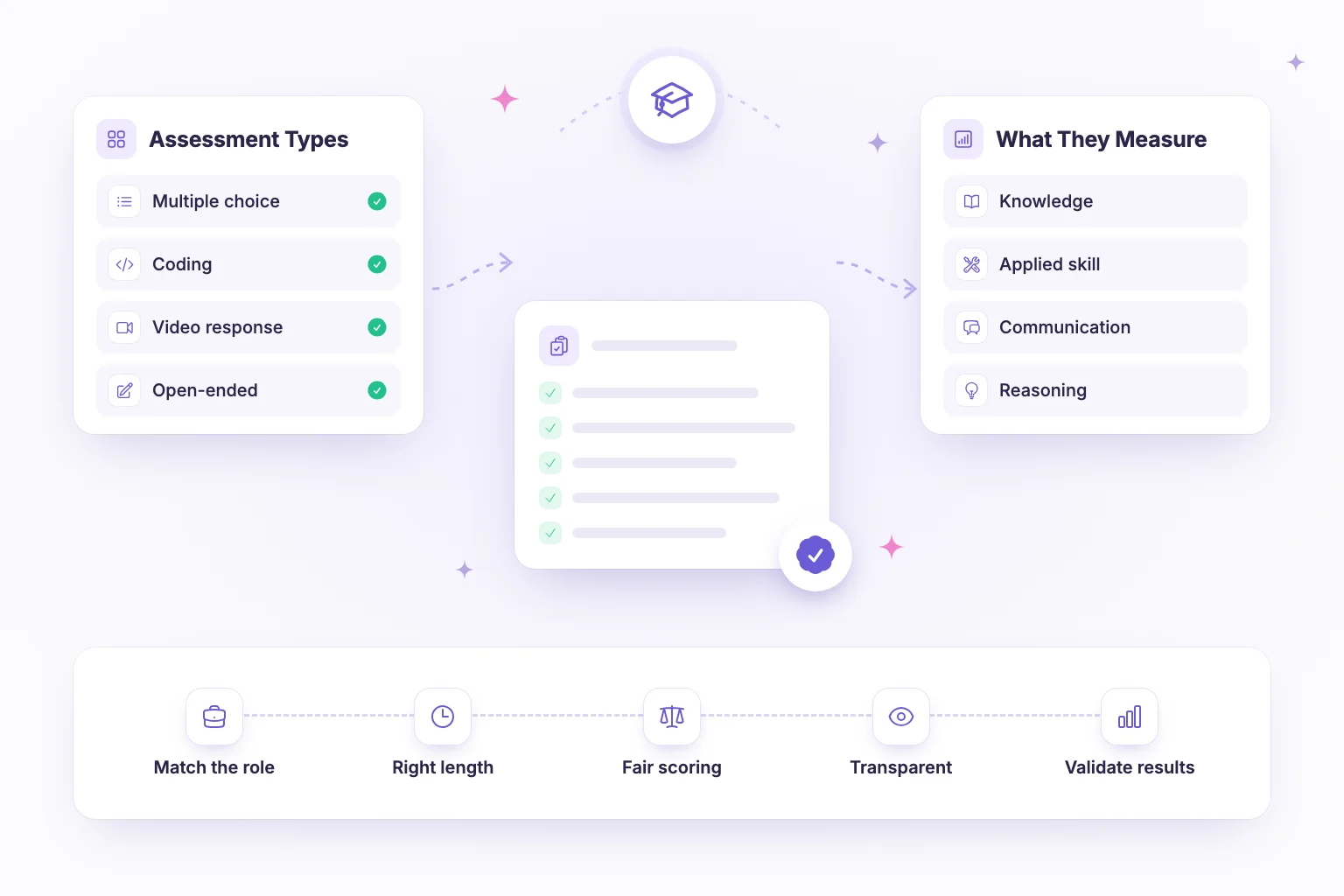
Pre-employment assessments are structured tests that candidates complete before an offer, designed to measure whether they have the skills, knowledge and working style a role requires. The most useful ones mirror the real job: skills tasks and work samples for practical ability, knowledge questions for fundamentals, and written or video responses for communication and reasoning. Choose the mix based on what actually predicts success in the role, keep it short, and tell candidates exactly what to expect.
This guide covers the main types of pre-employment tests, what each one tells you, how to choose between them, and how to keep the process fair.
Why use pre-employment assessments at all?
Resumes and unstructured interviews tell you what a candidate says they can do. An assessment shows you what they can do, under the same conditions as every other applicant. That consistency matters for three reasons:
- Better signal: job-related tasks reveal ability that job titles and keywords hide.
- Fairer comparison: every candidate answers the same questions and is scored against the same criteria.
- Less wasted interview time: interviewers spend their hours on candidates who have already shown the core skills.
Getting hiring wrong is costly. The U.S. Department of Labor estimates a bad hire can cost at least 30% of the employee's first-year earnings. A well-designed assessment is one of the cheapest ways to reduce that risk. It also underpins a skills-based hiring approach, where evidence of ability matters more than credentials.
Types of pre-employment tests and what each predicts
Skills tests
Skills tests ask candidates to apply a specific ability, such as writing code that passes test cases, cleaning a dataset or drafting a support reply. They predict whether someone can perform core tasks from day one. For engineering roles, a real coding exercise in a proper editor is far more informative than trivia. We explain why in why real coding assessments produce better hires.
Work sample tests
A work sample is a scaled-down version of an actual task from the job: reviewing a pull request, prioritising a backlog, or responding to a realistic customer scenario. Because they are so close to the real work, work samples tend to be among the strongest predictors of on-the-job performance. The trade-off is length, so keep them tightly scoped.
Knowledge tests (multiple choice)
Multiple choice questions check understanding of concepts, tools or rules: SQL joins, accounting principles, security basics. They are quick to take, can be scored automatically and are well suited to early filtering in high-volume roles. They predict baseline knowledge, not the ability to apply it, so pair them with a practical task.
Written response tests
Open-ended written questions ask candidates to explain a decision, outline an approach or analyse a scenario. They reveal reasoning, structure and written communication, which matter in almost every knowledge role and especially in remote teams that rely on written collaboration.
Video response tests
Candidates record short answers to set prompts on their own schedule. Video responses show spoken communication, clarity and how someone explains their thinking, without the scheduling cost of a live screen. They work well for customer-facing, sales, support and leadership roles.
Comparing pre-employment test types
| Test type | What it predicts | Best for | Typical length | Scoring |
|---|---|---|---|---|
| Skills test (e.g. coding) | Ability to perform core tasks | Technical and specialist roles | 30 to 60 min | Test cases plus reviewer rubric |
| Work sample | On-the-job performance | Mid to senior roles | 45 to 90 min | Reviewer rubric |
| Knowledge MCQ | Baseline understanding | Early filtering, high volume | 10 to 20 min | Automatic |
| Written response | Reasoning and written communication | Most knowledge roles | 10 to 20 min | Reviewer rubric |
| Video response | Spoken communication and clarity | Customer-facing and leadership roles | 5 to 15 min | Reviewer rubric |
For a deeper look at how each format connects to job performance, read the five assessment question types that predict job performance.
How to choose the right pre-employment assessment
- List the four to six skills that matter most. Pull them from the job description and ask the hiring manager what separates a strong performer from an average one after six months.
- Match each skill to a format. Practical skills go to a coding task or work sample; fundamentals to MCQs; communication to written or video answers.
- Decide on weighting. The skills used every day should carry the most points.
- Write a scoring rubric before you launch. Define what a strong, acceptable and weak answer looks like for every open-ended and practical question.
- Pilot it internally. Have one or two people in the role take it. If they struggle or it takes much longer than planned, adjust.
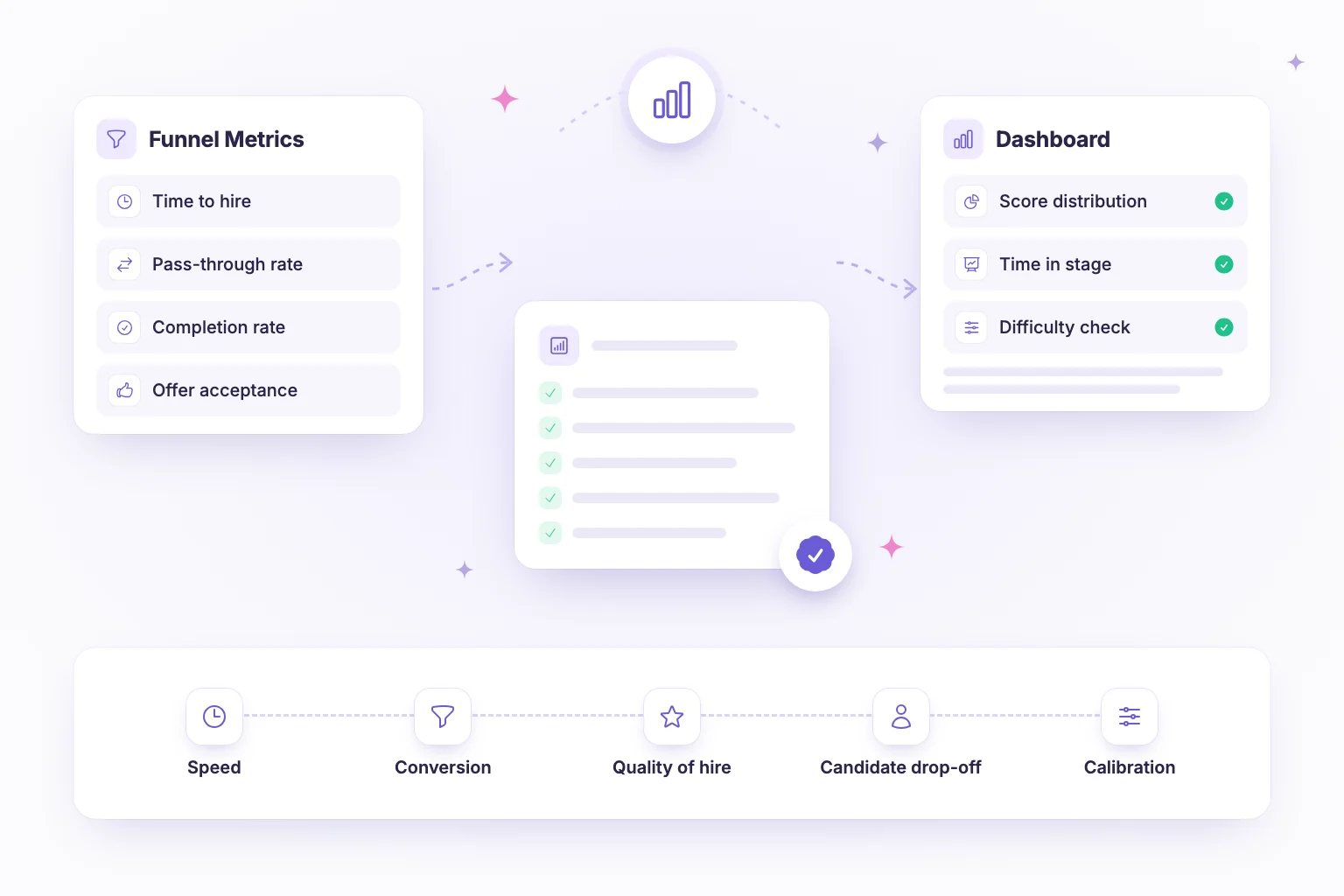
- Review results after the first cohort. Check completion rates, score distributions and whether any question is so easy or hard that it tells you nothing.
Assessment length and candidate experience
The best assessment is one candidates actually finish. A few practices make a large difference:
- Keep it proportionate. Entry-level and high-volume roles should be shorter; senior roles can justify a longer work sample, but rarely more than 90 minutes.
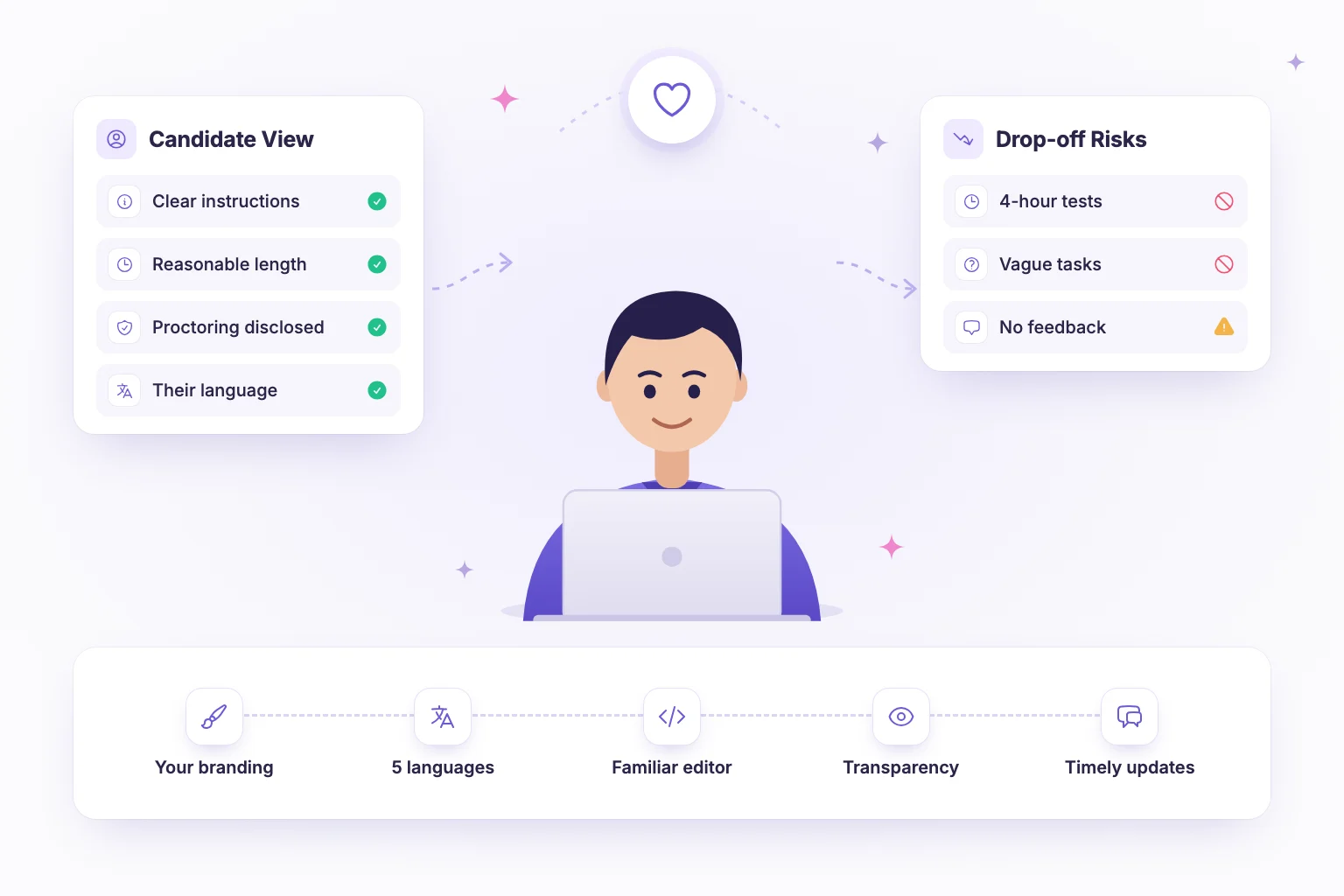
- Be upfront. Tell candidates the number of sections, the question types, the expected duration and whether it is proctored.
- Allow flexibility. Asynchronous assessments let candidates choose a time that suits them, which matters across time zones and for people currently employed.
- Use a familiar environment. For coding, an editor with syntax highlighting and autocomplete removes friction that has nothing to do with skill.
- Brand it. A clean, branded experience in the candidate's language signals that you take their time seriously.
More ideas are in our guide to candidate experience in technical assessments.
Fairness and transparency
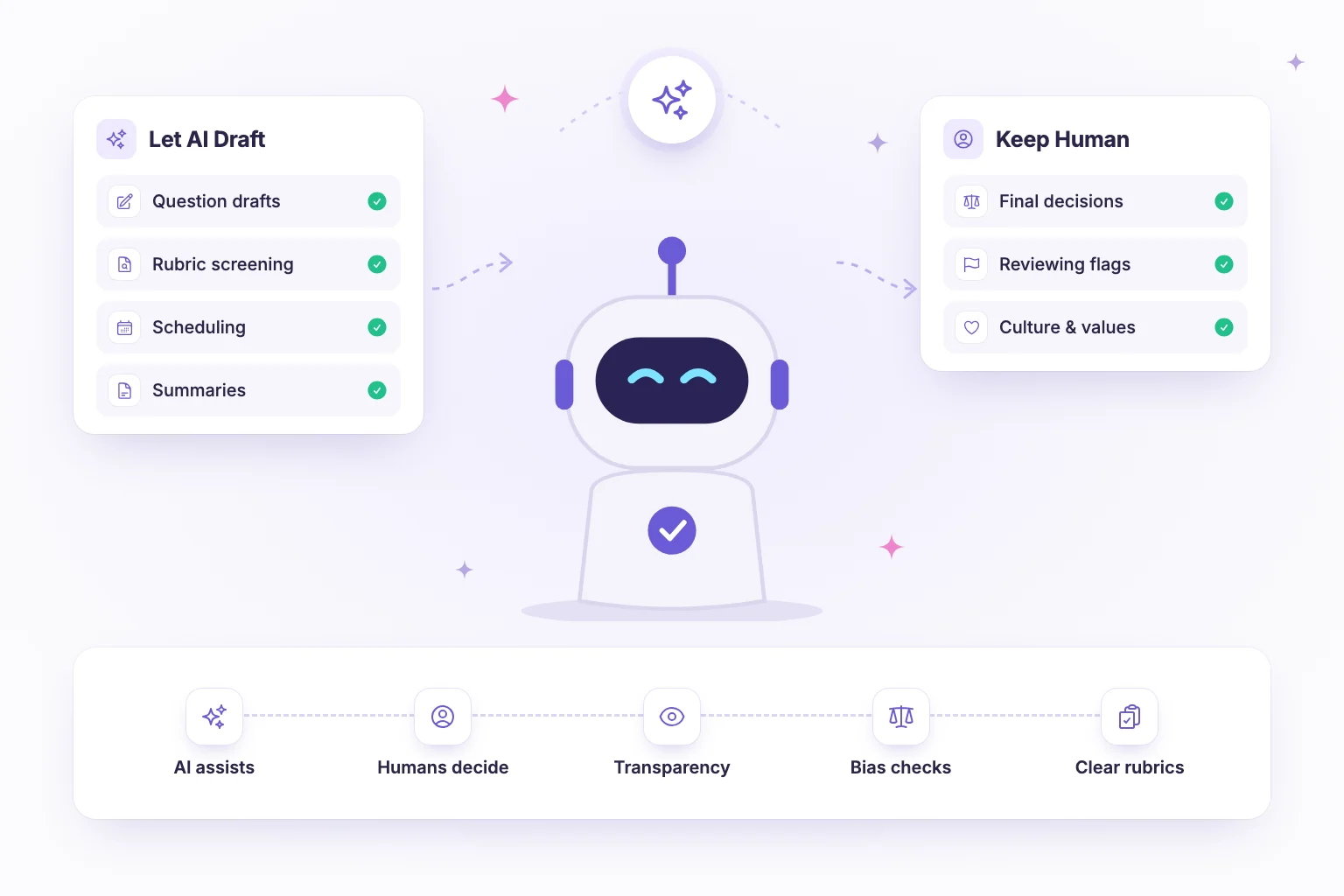
A fair assessment is job-related, consistent and explainable. Every question should tie back to a requirement of the role. Every candidate for the same role should take an equivalent test under the same conditions. And every score should be traceable to a rubric that a reviewer can explain.
If you use proctoring to protect integrity, say so before the assessment starts and explain what is monitored. Treat any flags as evidence for a human to review, not an automatic verdict. Offer accommodations, such as extra time, when candidates request them, and review score patterns periodically to check that no question behaves unexpectedly for particular groups.
Common pre-employment testing mistakes
Even well-intentioned assessments can backfire. These are the mistakes we see most often, and how to avoid them:
- Testing what is easy to test, not what matters. Trivia about syntax or definitions is simple to score but says little about how someone performs. Start from the skills list, not from a question bank.
- One test for every role. A generic assessment for all engineers, or all analysts, ignores differences in seniority and focus. A senior backend role and a junior frontend role need different questions.
- No rubric for open-ended answers. Without agreed criteria, two reviewers can score the same answer very differently. Define what strong, acceptable and weak look like before anyone reviews.
- Using the score as the only decision. An assessment is one input. Use it to decide who progresses and to shape interview questions, then combine it with structured interviews for the final decision.
- Never revisiting the test. Questions leak, roles change and some items turn out to be too easy. Review the assessment after every hiring cycle and retire questions that no longer discriminate between candidates.
- Surprising candidates. Unannounced proctoring, hidden time limits or an unexpectedly long test damage trust and completion rates. Tell candidates what to expect.
How NirnAI helps with pre-employment assessments
NirnAI gives you the building blocks for job-related, consistently scored assessments without weeks of setup.
- Four question types: auto-scored multiple choice; coding in an in-browser editor with syntax highlighting, autocomplete and test cases across 9 languages; video responses; and open-ended written answers. See the full range on the assessments page.
- AI question generation: paste or upload a job description and NirnAI extracts the skills and seniority, then drafts role-specific questions. You review and edit everything before publishing, and can clone assessments for similar roles.
- Consistent scoring: MCQs score automatically, coding answers run against test cases, and structured scorecards keep reviewers rating written and video answers against the same rubric.
- Analytics: completion rates, score distributions, section-level breakdowns and difficulty calibration show whether your assessment is working.
- Candidate experience: custom branding and a platform available in five languages.
Ready to build your first role-specific assessment? Start a 14-day free trial and generate one from your next job description.
Frequently asked questions
- Are pre-employment assessments legal?
- In most jurisdictions, pre-employment assessments are lawful when they are job-related, applied consistently to every candidate for the role, and do not screen people out on protected characteristics. Base every question on the actual requirements of the job, keep records of how scores are used, and offer reasonable accommodations. Check local employment law or consult counsel for your specific situation.
- How long should a pre-employment assessment be?
- For most roles, aim for 30 to 90 minutes in total. Short knowledge checks can take 15 to 20 minutes, while a coding task or work sample may need 45 to 60. Longer tests tend to lower completion rates, especially among experienced candidates with several offers. State the expected duration before the candidate starts.
- Which type of pre-employment test is the most predictive?
- Tests that closely resemble the real work, such as work samples and practical skills tasks, are generally the strongest signal because they show what a candidate can actually do. Knowledge MCQs are useful for efficient early filtering, and written or video responses add insight into communication and reasoning. A combination usually beats any single test type.
- Should I tell candidates how the assessment is scored?
- Yes. Explaining what the assessment covers, roughly how long it takes, how it is scored and whether it is proctored helps candidates prepare and perform at their real level. Transparency also builds trust and reduces drop-off. You do not need to share the exact answers or rubric weights, but the broad criteria should be clear.