Tuesday, March 17, 2026
How to Hire Software Engineers: A 7-Step Process That Works

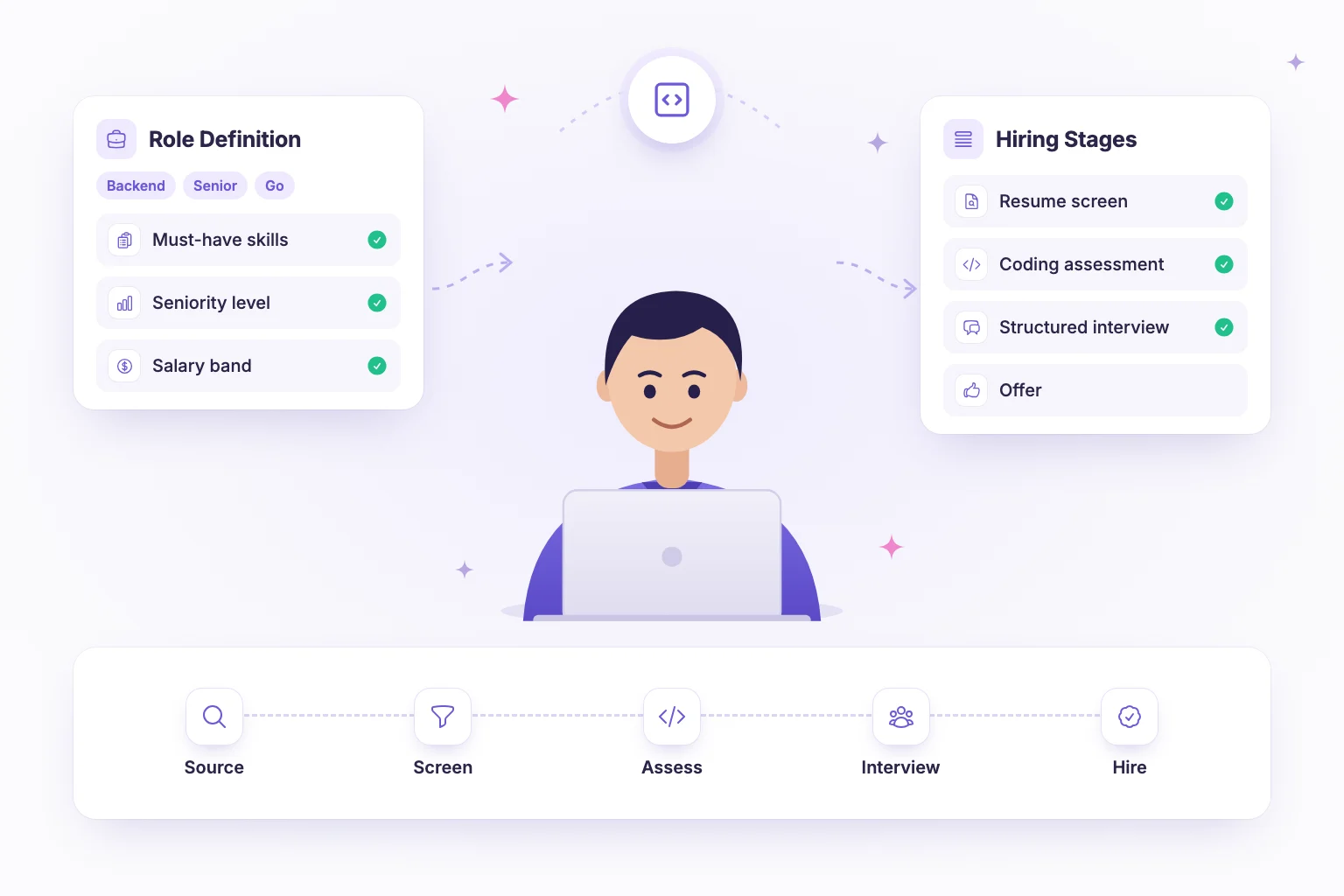
How to hire software engineers well: define the role in terms of skills and outcomes, source from several channels, screen for those skills early, test practical coding ability with a realistic task, run structured interviews with a shared scorecard, and make a fast, evidence-based decision. The process below turns those steps into a repeatable system that a recruiter, a hiring manager and a few engineers can run together.
Most engineering hiring problems are not caused by a shortage of candidates. They come from vague role definitions, inconsistent interviews and long gaps between stages. Fixing the process fixes most of the outcomes. Here is how to hire software engineers step by step.
How to hire software engineers: the technical hiring process at a glance
Before going deep on each step, here is the full software engineer interview process with a suggested owner and time budget for each stage. Time budgets are elapsed working time, not effort.
| Stage | Owner | Output | Time budget |
|---|---|---|---|
| 1. Define the role | Hiring manager + recruiter | Skills profile, level, scorecard | 1–2 days |
| 2. Sourcing | Recruiter | Qualified applicant pool | Ongoing, 1–3 weeks |
| 3. Skills screen | Recruiter | Shortlist against the rubric | 1–2 days per batch |
| 4. Practical assessment | Engineering reviewer | Scored coding and written work | 3–5 days including candidate time |
| 5. Structured interviews | Interview panel | Completed scorecards | 3–5 days |
| 6. Decision | Hiring manager | Hire / no hire with evidence | Within 1–2 days of final interview |
| 7. Offer | Recruiter + hiring manager | Signed offer | 2–5 days |
If a stage regularly overruns its budget, that is where to look first when you want to reduce time to hire.
Step 1: Define the role in skills, not job titles
"Senior backend engineer" means different things at different companies. Start with a short intake meeting between the hiring manager and recruiter and write down:
- The outcomes the person should deliver in their first six to twelve months (for example, "own the billing service and cut incident volume").
- Four to six must-have skills, such as API design, relational data modelling, debugging production issues and code review.
- Nice-to-have skills that you will not screen out on.
- Seniority expectations: scope of ownership, ambiguity they can handle, and whether they mentor others.
- Hard constraints: work authorisation, time zone overlap, on-call expectations.
This skills profile becomes the backbone of everything that follows: the job ad, the screening rubric, the assessment and the interview scorecard. When you write the ad, describe outcomes and must-have skills rather than a long list of technologies.
Step 2: Source from more than one channel
Relying on a single job board produces a narrow, noisy pipeline. Combine several sources and track which ones produce candidates who pass the practical stage, not just which ones produce the most applicants.
- Referrals from your own engineers, with the skills profile shared so referrals match the role.
- Inbound applications from a clear, specific job description.
- Outbound sourcing on professional networks and open-source communities.
- Past candidates who reached late stages for earlier roles.
- Campus and early-career programmes for junior roles.
Keep outreach messages short and specific: what the team builds, the problem the role will own and what the process looks like. Candidates are more likely to engage when they know the interview steps up front.
Step 3: Screen for skills early
The first filter should check for evidence of the must-have skills, not for keywords, school names or years of experience alone. A consistent screening rubric lets recruiters shortlist quickly and explain their decisions.
Two practical options work well together:
- Resume screening against a rubric. Score each resume on the must-have skills, with a short note of the evidence. Separate knockout criteria (hard requirements) from weighted criteria (skills that add points).
- A short online screen. Ten to fifteen multiple-choice questions on core concepts, plus one small coding problem, taking 20 to 30 minutes. This is especially useful when you receive large applicant volumes.
Keep the screen short. Its job is to remove clear mismatches, not to make the final call.
Step 4: Run a practical coding assessment
The practical assessment is where you see how a candidate actually works. Good practical assessments mirror the job: reading and extending existing code, writing a function against a spec with test cases, or debugging a failing module. Puzzle-style algorithm questions tell you little about day-to-day engineering. We explain why in why real coding assessments produce better hires.
What a good practical assessment looks like
- 60 to 90 minutes, timed, with a clear brief.
- One or two coding tasks with visible and hidden test cases.
- One open-ended written question, such as "How would you change this design if traffic grew tenfold?"
- The candidate's choice of language where the role allows it.
- Transparent rules on what resources are allowed, shared before the candidate starts.
Whether you run this as a take-home or live exercise is a real trade-off. Many teams use a timed practical followed by a live discussion of the solution, which combines the strengths of both.
Step 5: Structured technical interviews
Unstructured conversations feel natural but produce inconsistent, hard-to-compare results. Structured interviews ask every candidate the same core questions and rate answers against pre-agreed anchors.
A typical panel for a mid-level or senior engineer:
- Technical deep dive (60 min): walk through the practical assessment, then extend it. Ask about trade-offs, testing and failure modes.
- System design (45–60 min, senior roles): a realistic problem scoped to the team's domain.
- Collaboration and ownership (45 min): behavioural questions such as "Tell me about a time you disagreed with a technical decision. What did you do?"
Assign each interviewer specific competencies from the skills profile so no two interviews measure the same thing. Each interviewer fills in a scorecard independently before any debrief. For a ready-to-use template, see our guide to the structured interview scorecard.
Step 6: Make an evidence-based decision
Hold a short debrief within a day or two of the final interview. Start by reading the scorecards, not by asking "so, what did everyone think?" Discuss competencies one at a time, focusing on evidence: what did the candidate say or do?
- Decide against the skills profile, not against other candidates in the pipeline.
- Treat a strong concern on a must-have skill as a blocker unless new evidence addresses it.
- Record the reasoning. It helps calibrate future hires and explains decisions to candidates.
Hiring decisions carry real cost. The U.S. Department of Labor estimates a bad hire can cost at least 30% of the employee's first-year earnings, which is why a clear, evidence-led decision step is worth the discipline.
Step 7: Make the offer quickly
Strong engineers often have several processes running at once. Once you decide, move fast:
- The hiring manager calls the candidate personally to share the decision and specific feedback on their strengths.
- The recruiter sends the written offer within one or two working days.
- Offer a follow-up conversation with a future teammate so the candidate can ask questions about the day-to-day work.
For candidates you do not hire, send a timely, respectful decision. Candidates who had a fair process often reapply or refer others.
Common mistakes when hiring developers
- Changing the bar mid-process. Lock the skills profile and scorecard before the first interview.
- Too many rounds. Each stage should measure something new.
- Slow feedback. Require scorecards within 24 hours of each interview.
- Ignoring candidate experience. Tell candidates the stages, time commitment and rules in advance.
- Scheduling by email. Back-and-forth over interview slots can add days per candidate.
How NirnAI helps you hire software engineers
NirnAI is built around the process above. Paste or upload your job description and AI question generation extracts the skills and seniority, then drafts role-specific multiple-choice, coding, open-ended and video questions. Your team reviews and edits every question before publishing, and you can clone and reuse assessments across similar roles.
For the practical stage, candidates code in an in-browser editor with syntax highlighting, autocomplete and test cases, in any of nine languages: Python, JavaScript, TypeScript, Java, C, C++, Go, Ruby and Rust. Standard proctoring runs on every plan and produces an integrity score and flags for a human reviewer to decide on.
Visual hiring workflows let you drag and drop stages, branch on assessment results and auto-advance candidates, while interview scheduling with Google Calendar and Microsoft Outlook lets candidates self-book slots. Structured scorecard templates keep every interviewer rating against the same rubric, and analytics show score distributions and time spent in each stage.
See how it fits your team on our tech hiring solution page, or start a 14-day free trial and build your first engineering assessment today.
Frequently asked questions
- How long does it take to hire a software engineer?
- It depends on seniority, market and how many stages you run, but most of the delay comes from gaps between stages rather than the stages themselves. Scheduling, slow feedback and waiting for a panel to meet all add days. Setting a time budget per stage, collecting scorecards within 24 hours and letting candidates self-book interviews are the fastest ways to shorten the process without cutting the steps that give you signal.
- How many interview rounds should a software engineering hire have?
- For most roles, three to four candidate-facing stages are enough: a short skills screen, a practical coding exercise, one or two structured interviews covering technical depth and collaboration, and a closing conversation. Each extra round should measure something the earlier ones did not. If two interviews test the same competency, merge them. More rounds rarely improve accuracy and they do increase candidate drop-off.
- Should I use a coding test for senior engineers?
- Yes, but make it proportionate and relevant. Senior candidates respond well to a short, realistic practical task followed by a live discussion of their approach, trade-offs and how they would extend it. Avoid long unpaid projects and puzzle-style questions. The goal is to confirm hands-on ability and then spend interview time on design judgement, mentoring and ownership, which matter more at senior levels.
- Who should own each stage of the technical hiring process?
- Recruiters typically own intake logistics, sourcing, resume screening and the offer process. Hiring managers own the role definition, the final decision and the closing conversation. Engineers on the team own the practical assessment review and technical interviews. Writing these owners down before the role opens avoids the most common failure: a candidate waiting days because nobody knew it was their turn to act.