Monday, July 27, 2026
How to Write a Job Description for Developers (With Template)

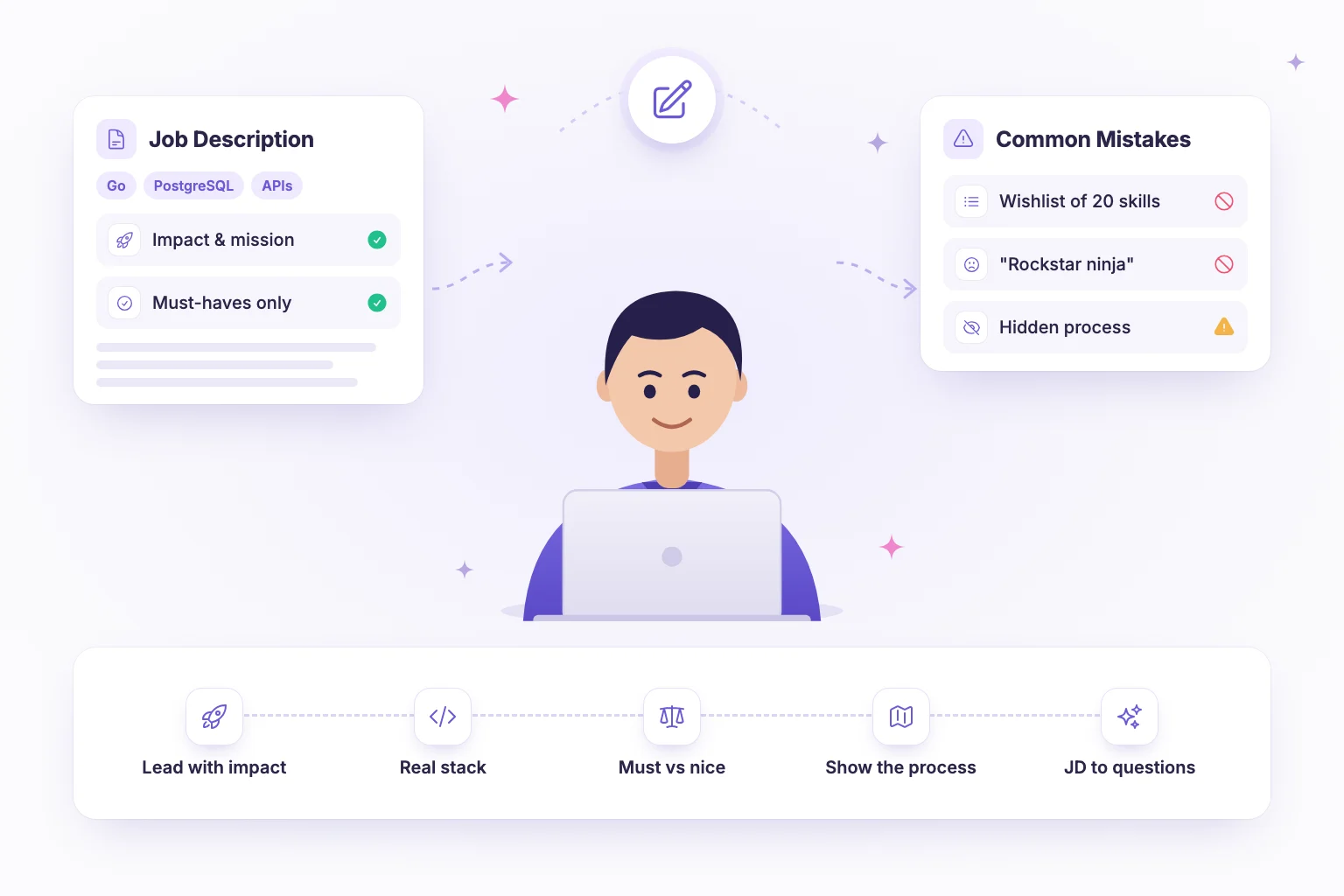
If you want to know how to write a job description that attracts strong developers, focus on five things: the impact of the role, the actual tech stack, a short list of genuine must-haves, the level and scope, and a transparent hiring process with a salary range where you can share one. Developers read job descriptions like specifications, so precision beats enthusiasm.
This guide covers the structure of a great developer job description, a copy-ready template, common mistakes and how to keep the language inclusive. It also shows why a clear JD pays off twice: once in the candidates it attracts and again as the input for your technical assessment.
Why developer job descriptions matter more than you think
A job description is the first filter in your hiring process. A vague one attracts a broad, poorly matched pool and discourages experienced engineers who cannot tell whether the role is worth their time. A specific one does part of the screening for you: candidates can see the stack, the level and the expectations, and self-select accordingly.
The JD also sets the evaluation criteria. If it lists four core skills, your assessment, interviews and scorecards should measure those four skills. When the JD and the process disagree, candidates notice, and hiring decisions become harder to defend.
How to write a job description: the structure that works
1. A title that matches the market
Use standard titles such as "Senior Backend Engineer" or "Frontend Developer (React)". Avoid internal jargon and novelty titles; candidates search for familiar terms, and unclear titles make the level hard to judge.
2. Impact: what this person will build
Open with two to four sentences on the problem the team solves and what the new hire will own in their first six to twelve months. "You will own the payments reconciliation service that processes every customer invoice" says more than "join our dynamic team".
3. The tech stack
List the languages, frameworks, databases and infrastructure the team actually uses today, and mention anything being migrated to or from. Be honest about legacy code; engineers will find out in the interview anyway.
4. Must-have vs nice-to-have skills
Separate requirements into two labelled lists. Keep must-haves to four to six items you will genuinely test. Everything else is a nice-to-have. Replace years-of-experience rules with capabilities where you can: "has designed and operated a REST API in production" is more useful than "5+ years of experience".
5. Level and scope
Describe the scope of decisions the role makes. Does the engineer implement designs, lead a feature end to end or set technical direction across teams? Mention who they report to and how large the team is.
6. Process transparency
List every stage of the hiring process, how long each takes and what it assesses. For example: a 45-minute online assessment, a 60-minute technical interview discussing the assessment, and a 45-minute conversation with the hiring manager. Candidates prepare better and drop out less when they know what is coming.
7. Compensation, location and benefits
Include a salary range where you can, the work arrangement (remote, hybrid or on-site, with time zone expectations) and the benefits that matter most, such as learning budget or flexible hours.
Software engineer job description template
Copy and adapt this template. Replace everything in square brackets.
[Job title], [Team]
[Location or remote, time zones] · [Salary range] · [Full-time/contract]
What you will do
[Two to four sentences on the product, the team and what this person will own in the first year.]
Our stack
[Languages, frameworks, databases, cloud and tooling. Note any migrations.]
You will need
[Four to six must-have capabilities, each testable.]
Nice to have
[Two to four genuinely optional skills.]
Level and team
[Scope of decisions, reporting line, team size.]
Our hiring process
[Stage 1: online assessment, duration, what it covers.] [Stage 2: technical interview.] [Stage 3: hiring manager conversation.] [Expected total time to decision.]
What we offer
[Benefits, learning budget, flexibility.]
Common mistakes to avoid
| Mistake | Why it hurts | Better approach |
|---|---|---|
| A long list of "required" technologies | Deters qualified candidates who miss one item | Four to six must-haves, the rest labelled optional |
| Rigid years-of-experience rules | Measures time, not ability | Describe what the person has done or can do |
| No stack details | Engineers cannot judge fit | List the real tools, including legacy parts |
| Hidden process | Surprise stages increase drop-off | Publish every stage and its duration |
| Generic culture copy | Wastes the most-read part of the page | Lead with impact and ownership |
| Mismatched level signals | Title says senior, duties say junior | Align title, scope and salary range |
Writing inclusive job descriptions
Inclusive language widens your pool without lowering the bar. A few practical checks:
- Drop "rockstar", "ninja" and "guru". They are vague and can read as exclusionary.
- Watch for coded adjectives such as "aggressive" or "dominant"; prefer "proactive" or "takes ownership".
- Avoid unnecessary degree requirements if equivalent experience would do.
- State flexibility clearly, including part-time or flexible hours if available.
- Add an encouragement line, such as "If you meet most of the requirements, we would still like to hear from you."
- Mention accommodations for the assessment and interviews, and how to request them.
Example: a filled-in backend developer job description
Here is how the template reads when completed for a mid-level backend role. Adapt the details to your team.
Backend Engineer (Python), Payments Team
Remote within UTC−1 to UTC+3 · [Salary range] · Full-time
What you will do: You will build and run the services that reconcile customer payments and invoices. In your first year you will own the reconciliation service, improve its reliability and help design a new event-driven billing pipeline.
Our stack: Python, FastAPI, PostgreSQL, Redis, Docker and AWS. We are gradually moving older batch jobs to event-driven services.
You will need: experience building and operating REST APIs in production; solid Python and automated testing; relational database design and query optimisation; the ability to debug issues across services; clear written communication for a remote team.
Nice to have: payments or financial systems experience; message queues; infrastructure as code.
Level and team: Mid-level. You will lead features end to end within a team of five engineers, reporting to the engineering manager.
Our hiring process: a 60-minute online assessment with a Python coding task and short design questions; a 60-minute technical interview where we discuss your solution; a 45-minute conversation with the hiring manager. We aim to decide within three weeks.
Notice that every must-have is something the assessment and interviews can actually measure, and the process section tells candidates exactly what to prepare for.
From job description to technical assessment
A well-written JD is more than a job ad. It is a structured list of the skills, stack and seniority the role requires, which is exactly what you need to build a fair assessment. If the must-have list says "designs relational database schemas" and "writes tested Python services", the assessment should include a schema question and a Python coding task with test cases.
This is also where AI can save hours. Our walkthrough on turning a job description into a test in minutes shows the process in detail, and how to hire software engineers covers the stages that follow.
How NirnAI turns your job description into an assessment
In NirnAI, the job description you just wrote becomes the starting point for evaluation. With AI question generation, you paste or upload the JD and NirnAI extracts the skills and seniority it describes, then generates role-specific questions across multiple choice, coding, open-ended and video formats. Recruiters and engineers review and edit every question before publishing, so the final assessment reflects your standards, not a generic template.
Coding questions run in an in-browser editor with syntax highlighting, autocomplete and test cases in nine languages, including Python, JavaScript, TypeScript, Java and Go. AI resume screening ranks applicants against a rubric built from the same skills, and structured scorecards keep interviews tied to the must-haves in your JD. Once an assessment works well, clone it for the next similar role.
Start a 14-day free trial and turn your next developer job description into a ready-to-review assessment.
Frequently asked questions
- How long should a developer job description be?
- Most effective developer job descriptions run between 400 and 700 words. That is long enough to explain the impact of the role, the stack, the requirements, the level and the hiring process, but short enough to scan on a phone. Cut generic company boilerplate first; developers care most about what they will build, who they will work with and how they will be evaluated.
- Should I include a salary range in a job description?
- Where possible, yes. Many developers skip postings without a range, and a number of jurisdictions now require pay ranges in job ads, so check the rules for each location you hire in. A realistic range saves time for both sides and reduces late-stage drop-off. If you cannot publish a range, say when compensation will be discussed in the process.
- How many requirements should a developer job description list?
- Keep must-have requirements to around four to six items that genuinely predict success, and list nice-to-haves separately with a clear label. Long requirement lists discourage qualified candidates, particularly those who only apply when they meet every item. Each must-have should be something you will actually test during the assessment or interviews.
- Can a job description be used to create a technical assessment?
- Yes. A well-structured job description already lists the skills, stack and seniority the role needs, which is exactly the input an assessment requires. Tools with AI question generation can extract those skills and draft role-specific questions, which the hiring team then reviews and edits. The clearer the job description, the more relevant the resulting assessment.