Tuesday, March 10, 2026
Stop Losing Candidates: How Visual Hiring Workflows Replace Your Spreadsheet Chaos

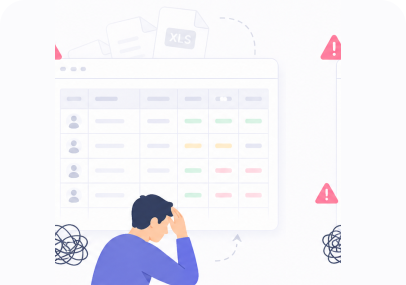
It is 4:47 PM on a Thursday. You have just finished a promising phone screen with a backend developer who checks every box. You make a mental note to schedule the technical assessment, then get pulled into a benefits meeting, then a hiring manager pings you about a different req, and then your kid's school calls.
Monday morning, you remember. You fire off the assessment link. No reply. Tuesday, you follow up. Wednesday, the candidate responds: "Thanks for getting back to me, but I accepted another offer over the weekend."
Sound familiar? According to Robert Half, 57% of job seekers lose interest if the hiring process takes too long. The problem is rarely that your team is slow at making decisions. The problem is that nobody automated the space between decisions.
That gap, the dead air between "phone screen passed" and "assessment sent," is where good candidates disappear. And spreadsheets, shared docs, and "just remembering" are not a system. They are a hope
This is the problem nirn.ai was built to solve. Not with more dashboards or another Kanban column, but with a visual hiring workflow that moves candidates forward automatically, branches based on results, and only asks you to step in when a human judgment call is genuinely needed.
What Is a Hiring Workflow, Really?
Strip away the software jargon, and a hiring workflow is just the sequence of steps a candidate goes through from "applied" to "hired" or "rejected." Every company has one. Most companies just never wrote it down, and the ones who did wrote it in a doc that nobody follows.
nirn.ai makes the workflow visual. You see the entire hiring process as a flowchart on screen, with boxes for each stage and arrows connecting them. Drag a stage, drop it where it belongs, draw an arrow to the next step. If you have ever used a presentation tool to make a flowchart, you already know how this works. No code. No IT ticket. No waiting three sprints for someone to configure your recruitment software.
Every stage in your workflow is one of five types:
- Assessment — An online test that candidates complete on their own time. Multiple choice questions, coding challenges in nine programming languages with a real code editor in the browser, video responses where candidates record themselves answering your prompts, and open-ended written answers. The platform scores objective questions automatically.
- Booking — An interview scheduling step that connects to Google Calendar and Microsoft Outlook. You choose whether the system auto-books the next available slot or lets the candidate pick from your team's open times. No more email tag about availability.
- Manual Review — This is where your team weighs in. Portfolio reviews, panel discussions, reference checks. The platform sends reminders so the review does not sit in someone's to-do list for a week.
- Notification — An automated email sent from a template you control. Rejection letters, next-step instructions, welcome messages. Write it once, personalize it with candidate details, and let the system send it at exactly the right moment.
- Status — The end of the road. Either "Hired" or "Rejected." Once a candidate lands here, their journey is complete and fully documented.
These five building blocks combine to represent virtually any hiring process, from a two-step startup screen to a six-round enterprise gauntlet.
See It in Action: Hiring a Software Engineer
Your company is hiring a mid-level software engineer. You open nirn.ai, select the "Standard" workflow template, and customize it in about ten minutes. The workflow branches: pass goes to scheduling, fail goes to rejection.
Two candidates enter the pipeline on the same Monday morning.
Sarah's Journey (The Strong Candidate)
Sarah applies and receives an automatic email with her assessment link. She completes it Tuesday evening. The platform auto-scores her results: 82%. That clears the 70% threshold, so the system automatically moves her down the pass path.
Within minutes, Sarah receives a booking email. She sees your team's available slots pulled from Google Calendar and picks Thursday at 2 PM. A calendar invite lands in her inbox and your interviewer's inbox simultaneously. No recruiter involved.
Thursday's interview goes well. The hiring manager opens nirn.ai, sees the Manual Review stage, and marks Sarah as "Pass." The system fires off an offer notification email. Sarah accepts. Her status moves to "Hired," and every step, timestamp, and score is recorded in her transition history.
Your total hands-on time as the recruiter? Approximately five minutes reviewing the outcome and confirming the offer details. Everything else happened automatically.
James's Journey (The Underqualified Candidate)
James applies the same Monday and completes the assessment Wednesday morning. His score: 45%. That falls below the 70% threshold, so the system routes him down the fail path automatically.
James receives a respectful, professional rejection email within minutes of his score posting. His status moves to "Rejected." The transition history logs exactly why: assessment score below threshold.
Your hands-on time for James? Zero. Not because you do not care, but because the outcome was objective and the communication was handled with dignity by a template you carefully wrote once.
What Just Happened
Two candidates. Two very different outcomes. One recruiter intervention. The workflow handled routing, scheduling, and communication. You handled the judgment call that actually required a human: reviewing the strong candidate after the interview.
Four Things That Make This Different
1. Branching Logic That Mirrors Real Decisions
Most recruitment tools give you a linear pipeline. Candidate moves from Column A to Column B to Column C. But hiring is not linear. A candidate who bombs the assessment should not sit in the same queue as someone who aced it.
nirn.ai lets you draw branches. Green edges for pass, red edges for fail. You set the conditions, and the system routes candidates accordingly. Strong candidates move fast. Weak candidates exit gracefully. Nobody falls through the cracks.
2. Calendar-Aware Scheduling That Eliminates Email Tag
Booking stages connect directly to Google Calendar and Microsoft Outlook. When a candidate reaches a scheduling step, the system either auto-books the next available slot or presents a self-service picker showing only genuinely available times. Conflicts, time zones, and double-bookings are handled before they happen.
3. AI-Powered Assessment Creation From Job Descriptions
nirn.ai includes a Quick Hire flow: paste your job description, and the platform generates a tailored assessment with relevant questions across multiple formats. You review and adjust the generated questions, then publish. What used to take half a day now takes fifteen minutes.
4. Templates and a Kanban Board You Can Override
Three workflow templates, Simple, Standard, and Comprehensive, get you started in one click. And for day-to-day management, your pipeline displays as a Kanban board. Each column is a stage, each card is a candidate. Need to fast-track a referral? Drag their card to any stage manually. The system logs the override in the transition history.
Your Daily View: The Pipeline at a Glance
Monday morning, you open nirn.ai and see your Pipeline board. At a glance:
- Twelve candidates are currently taking assessments. No action needed.
- Three candidates have passed and are in the booking stage. Two have self-scheduled. One has not clicked the link, and the system will send a reminder tomorrow.
- Two candidates are in Manual Review. One hiring manager has been sitting on a review for three days and the platform has already nudged them.
- Four candidates were auto-rejected last week based on assessment scores. All received professional rejection emails. All transitions are logged.
Your actual to-do list? Follow up with one slow hiring manager. Check in on an outstanding offer. That is it.
Compare that to the spreadsheet version: scanning rows trying to remember who is at what stage, copying email addresses, checking four different calendars, drafting rejection emails one at a time, and hoping you did not miss anyone.
The Audit Trail You Didn't Know You Needed
Every time a candidate moves between stages, whether automatically or by manual override, nirn.ai records it. The score that triggered advancement. The timestamp. Who made the decision. The email that was sent.
This matters for compliance, process improvement, and team accountability. When a candidate asks why they were rejected, you have a clear, documented answer. After a quarter, you can see where candidates drop off and where your bottlenecks hide.
Start With the Workflow You Have
You do not need to redesign your entire hiring process to get value from this. Most teams start by mapping their current process into the visual builder, automating the transitions that are already rules-based, and keeping manual review stages for decisions that genuinely need human judgment.
The result is not a radical change in how you hire. It is a radical change in how much of your week gets eaten by the logistics of hiring, so you can spend that time on the parts that actually require a recruiter's expertise: evaluating people, selling the role, and closing offers.
If you are tired of being the human glue between spreadsheets, calendars, and email threads, nirn.ai's visual workflow builder might be worth fifteen minutes of your time. Build your first workflow for free and see how many of your manual steps disappear.