Thursday, July 16, 2026
High-Volume Hiring: 8 Strategies to Screen Fairly at Scale

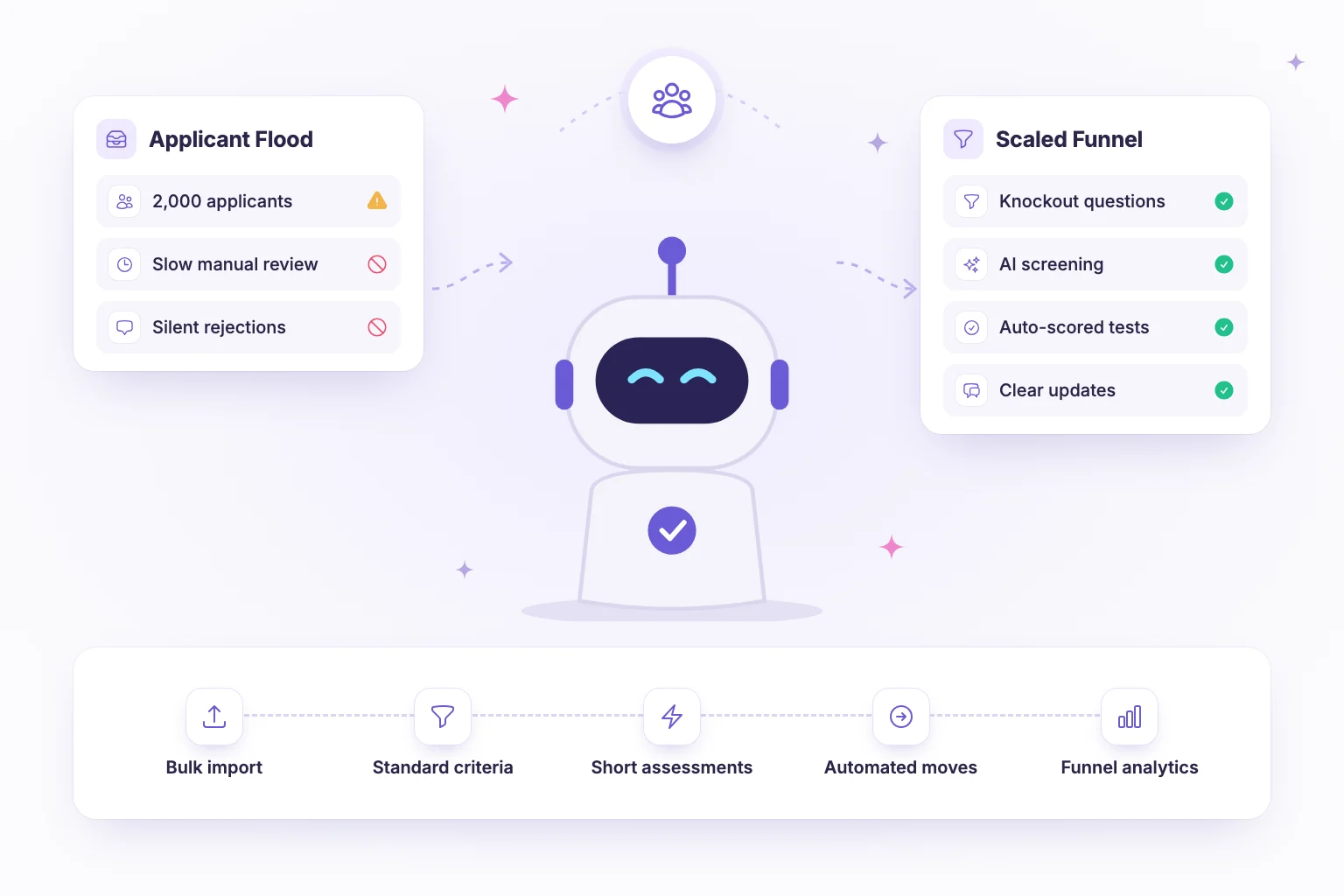
High-volume hiring works when you stop treating every applicant as a manual review and start treating the process as a funnel you design. Standardise the criteria up front, automate the early screening stages, use a few knockout questions and a short skills assessment, then spend human time on the smaller group that remains. Fairness comes from applying the same job-related steps to everyone.
Below are eight practical strategies for screening large applicant pools, a table of funnel stages you can adapt and the mistakes that make high-volume recruiting slow or unfair.
Why high-volume recruiting breaks traditional processes
A process that works for ten applicants collapses at a thousand. Recruiters skim resumes in seconds and rely on shortcuts like familiar company names. Interview calendars fill up with candidates who were never a match. Strong applicants wait days for a reply and accept offers elsewhere. And because each reviewer applies slightly different standards, outcomes depend on who happened to open the application.
The fix is not working harder. It is designing each stage so it can handle volume consistently, and deciding in advance which stages need people and which do not.
Strategy 1: Standardise criteria before applications open
Write down the three to six skills or requirements that genuinely predict success in the role, and agree on them with the hiring manager before the job goes live. Separate true must-haves (for example, legal right to work in a location, or working proficiency in a specific language) from preferences. Every later stage, from knockout questions to interview scorecards, should trace back to this list. Our skills-based hiring guide explains how to turn a role into measurable criteria.
Strategy 2: Use a small number of knockout questions
Knockout questions are short, objective questions that remove applicants who cannot meet a non-negotiable requirement. Keep them few and truly binary:
- "Are you able to work from our Berlin office three days per week?"
- "Are you available to start within the next eight weeks?"
- "Can you work the weekend shift pattern described in the job ad?"
Avoid knockout questions that are really preferences, such as a fixed number of years of experience. They remove capable people without measuring skill.
Strategy 3: Automate resume screening against a rubric
At volume, resumes should be ranked against the criteria you set, not read top to bottom in arrival order. Automated candidate screening scores each resume against a rubric of the skills the role needs, so recruiters start with the most relevant applicants and review the reasoning rather than the raw pile. Treat the ranking as a prioritisation tool, not a final decision, and spot-check lower-ranked resumes regularly. For more techniques, see how to screen resumes faster.
Strategy 4: Replace early phone screens with short assessments
A 20 to 45 minute online assessment gives better signal than a resume and costs far less than a phone screen. Use auto-scored formats for the first round:
- Multiple choice for knowledge and reasoning.
- Short coding tasks with test cases for technical roles.
- One open-ended or video question to capture communication, reviewed only for candidates who pass the objective sections.
Keep the test short and relevant. Long assessments at the top of the funnel drive away experienced candidates who have options.
Strategy 5: Automate stage transitions
Much of the delay in high-volume hiring is waiting: a candidate finishes an assessment and sits there until someone notices. Define rules so that candidates who meet the threshold move automatically to the next stage, such as interview booking, and those who clearly do not receive a timely, polite update. Recruiters then work on exceptions rather than routine moves.
Strategy 6: Review in batches, not one by one
Batch reviews are faster and more consistent. Set fixed review sessions, for example twice a week, where reviewers score a group of open-ended answers or borderline candidates side by side using the same rubric. Seeing responses together makes it easier to calibrate and reduces the drift that happens when one person reviews applications at random times over weeks.
Strategy 7: Communicate at every stage
Large pools mean large numbers of people who will not be hired. How you treat them affects your reputation and future applications. Tell candidates at the start how many stages there are and how long each takes, send an update when they move or stop, and set a maximum response time you actually meet. Automated but personal messages are far better than silence.
Strategy 8: Measure the funnel and audit for fairness
Track conversion between stages, time spent in each stage and assessment score distributions. If one stage has an unusually low pass rate, check whether the questions are too hard or unrelated to the job. Compare outcomes across groups where you legally can, and investigate unexplained gaps. See recruiting metrics that matter for which numbers to watch.
High-volume hiring funnel stages
| Stage | Purpose | Method | Human involvement |
|---|---|---|---|
| Application and import | Collect every candidate in one place | Job board applications, bulk CSV import | None beyond setup |
| Knockout questions | Confirm non-negotiable requirements | Two to four yes/no questions | None |
| Resume screening | Prioritise relevant applicants | Ranking against a skills rubric | Spot-checks |
| Short assessment | Measure core skills | Auto-scored MCQ and coding, one open-ended item | Borderline review |
| Integrity review | Check flagged attempts | Proctoring flags and evidence | Reviewer decides |
| Structured interview | Assess depth and fit for the role | Scorecard-based interview | Full |
| Offer | Close the candidate | Calibrated decision, fast offer | Full |
Mistakes to avoid in bulk hiring
- Adding stages to cope with volume. Every extra step increases drop-off; make existing steps better instead.
- Using proxies instead of skills. School names and employer brands are fast to filter on and poor at predicting performance.
- Treating automation as the decision. Rankings and flags should direct attention; people should make the calls.
- Letting criteria drift. If the bar moves halfway through, early and late applicants are judged differently.
Preparing your team for a high-volume intake
Most high-volume problems are planning problems. Before the job goes live, work through this checklist with the hiring manager and reviewers:
- Estimate the pool. Use past intakes to forecast applications, then work backwards to how many candidates each stage can realistically handle.
- Build and test the assessment. Have two or three current employees take it. If they struggle to finish, shorten it or simplify the wording.
- Set thresholds in advance. Decide the pass mark and what happens to borderline scores, and write it down.
- Book reviewer time. Put batch review sessions and interview blocks in calendars before the first application arrives.
- Prepare message templates. Draft the invitation, reminder, progression and rejection messages so they go out on time.
- Assign an owner for exceptions. Someone needs to handle technical issues, accommodation requests and retake decisions quickly.
With these decisions made up front, the team can react to volume instead of improvising criteria while applications pile up. After the intake closes, hold a short retrospective: which stage lost the most good candidates, which took the longest, and what would you change before the next round?
How NirnAI helps with high-volume hiring
NirnAI is designed to move large pools through a consistent process. Bulk import candidates from CSV to bring everyone into one pipeline, then use AI resume screening to rank resumes against a rubric of the skills the role needs. Short online assessments combine auto-scored multiple choice and coding questions, with an in-browser editor and test cases across nine languages, plus open-ended and video questions for the candidates who progress.
With visual hiring workflows, you build stages with drag and drop, branch on assessment results and let qualifying candidates auto-advance to interview booking, where they self-book slots from connected Google or Outlook calendars. Standard proctoring on every plan produces an integrity score and flags that a human reviewer decides on. Structured scorecards keep interviews consistent, and analytics cover completion rates, score distributions, pipeline funnel and time in each stage, so you can spot bottlenecks early.
Explore the high-volume hiring solution, or start a 14-day free trial and run your next large intake through a single, fair funnel.
Frequently asked questions
- What counts as high-volume hiring?
- High-volume hiring usually means filling many similar roles at once, or receiving hundreds or thousands of applications for a small number of openings. Examples include support and operations teams, graduate intakes and fast-growing engineering teams. The defining feature is that manual review of every applicant is no longer practical, so the process has to be standardised and partly automated.
- How do you keep high-volume screening fair?
- Agree on job-related criteria before applications open, apply the same knockout questions and assessment to every candidate, and score objective answers automatically. Review borderline cases by hand against a shared rubric, audit pass rates regularly for unexpected gaps between groups, and avoid filters that do not measure the job, such as school name or unexplained resume gaps.
- How long should a screening assessment be for high-volume roles?
- Aim for 20 to 45 minutes for the first assessment. Longer tests increase drop-off, and the strongest candidates are often the first to leave a slow process. Use the short assessment to separate clearly qualified from clearly unqualified applicants, and save deeper exercises, such as longer coding tasks or structured interviews, for the smaller group that progresses.
- Can automation replace recruiters in high-volume hiring?
- No. Automation handles repetitive work such as importing candidates, ranking resumes, scoring multiple choice and coding tests and moving people between stages. Recruiters and hiring managers still set the criteria, review borderline candidates, decide on integrity flags, run interviews and make offers. The goal is to spend human time where judgement matters, not on inbox management.