Wednesday, February 18, 2026
Why Always-On Proctoring Is the New Standard for Remote Technical Assessments

Remote hiring is no longer a temporary measure. It is the operating model for technical recruitment at companies of every size. With that shift comes an uncomfortable question: how do you know the person who aced your coding assessment is the same person who will show up on day one?
The integrity of remote technical assessments has become a board-level concern. Reports from hiring teams consistently describe the same pattern: candidates who perform brilliantly on take-home tests but struggle with basic tasks once hired. The cost is not just a bad hire. It is months of lost productivity, damaged team morale, and the expense of starting the search over again.
Online proctoring software has existed for years, but most platforms treat it as an afterthought: an expensive add-on that only gets activated for senior roles or final-round assessments. That approach creates a gap. If proctoring is optional, most assessments go unmonitored. If it costs extra, budget constraints push teams toward the unproctored path.
The emerging standard is different. Always-on proctoring, where every assessment is monitored by default, removes the guesswork and closes the integrity gap across your entire hiring pipeline.
The Problem with Optional Proctoring
When proctoring is sold as a premium tier, organizations face an awkward decision at every stage of the hiring funnel. Do you spend the extra budget to proctor a first-round screening? Probably not. Do you proctor the final technical round? Maybe, if the role justifies the cost.
The result is inconsistency. Candidates taking the same assessment for the same role may face entirely different levels of oversight. That inconsistency introduces legal risk, undermines fairness, and makes it harder to compare candidates on equal terms.
What Always-On Proctoring Looks Like
At nirn.ai, proctoring is included in every plan. It is not an add-on, not a premium feature, and not something a recruiter has to remember to enable. Every assessment is proctored by default.
Browser-Level Monitoring
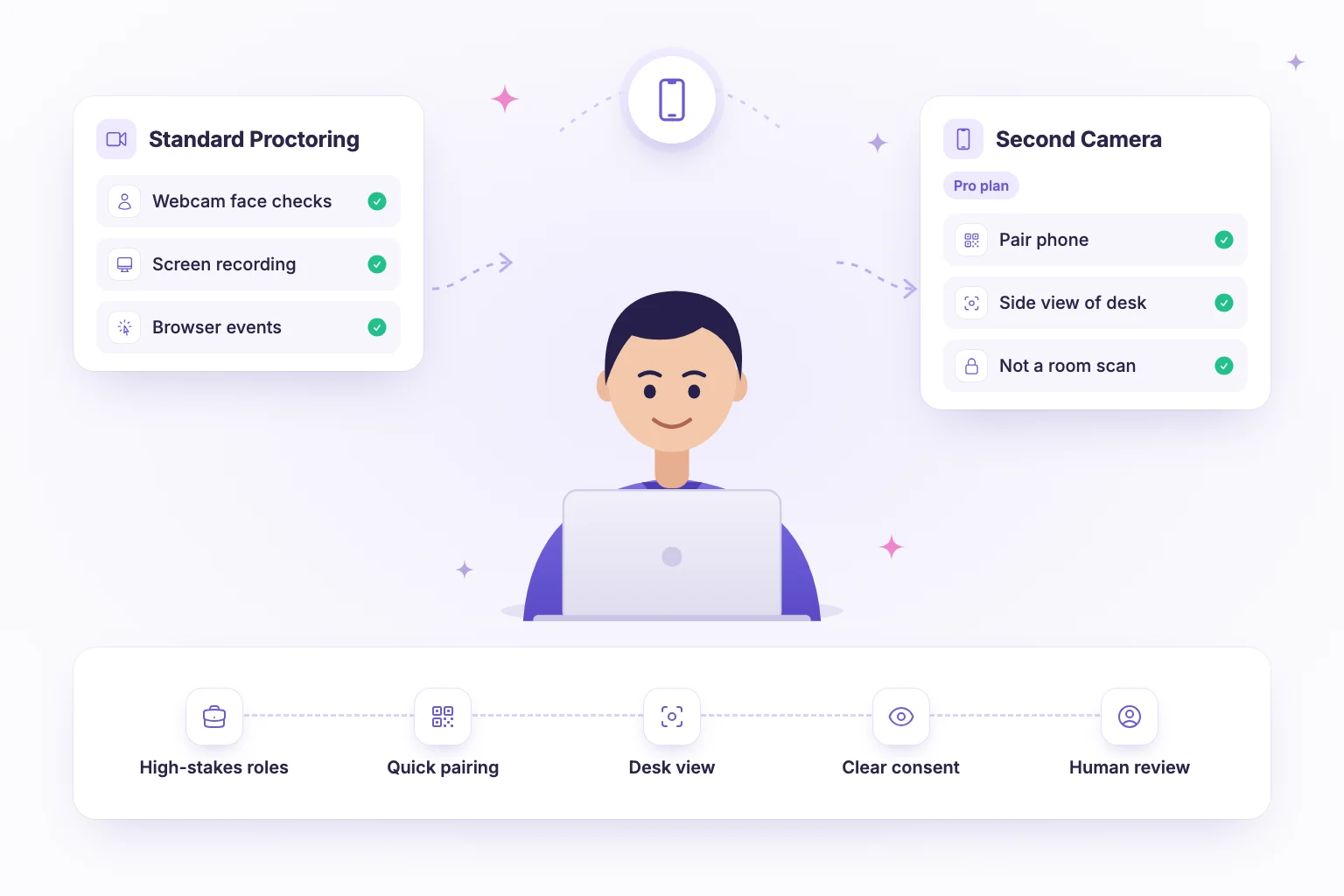
The platform tracks tab switches, copy-paste attempts, right-click menu access, and keyboard shortcuts. Fullscreen enforcement requires candidates to remain in the assessment window, with exit and re-entry events logged. If a candidate exceeds a configurable violation threshold, the system can automatically submit the assessment.
Camera and Screen Recording
Continuous camera recording captures the candidate throughout the session, with snapshots taken every five seconds. Screen recording runs in parallel, capturing activity in thirty-second chunks. Everything runs in the browser, no desktop software required.
Multi-Monitor Detection
The platform employs ten different browser-based detection methods to identify multi-monitor setups, making it significantly harder to use a secondary display without triggering a flag.
AI-Powered Analysis: Beyond Rule Checking
The volume of data generated by continuous monitoring would overwhelm human reviewers if they had to watch every session. AI analysis changes the equation.
The platform uses AWS Rekognition to perform automated analysis on camera data:
- Face detection and matching: Confirms whether a face is present and flags frames where multiple faces appear.
- Head pose tracking: Sustained looking away from the screen can indicate reading from notes or a secondary device. The system flags sessions where head orientation exceeds thresholds for extended periods.
- Object detection: Identifies phones, books, additional laptops, tablets, headphones, and earbuds near the candidate.
Reviewers see a curated set of flagged events alongside assessment results, with timestamps linking directly to the relevant recording moments. No need to watch hours of video.
The Trust Score: Making Integrity Data Actionable
Every assessment submission includes a composite trust score that aggregates all proctoring signals into a single, reviewable metric. Hiring managers reviewing twenty submissions do not have time to dig through event logs for each one. The trust score gives them an immediate signal about which submissions warrant closer inspection.
Configurable thresholds mean different roles can define different strictness levels. A screening assessment for a junior role might tolerate a few tab switches. A final-round assessment for a senior security engineer might enforce zero tolerance.
Candidate Experience: Fairness, Not Surveillance
The most common objection to proctoring is that it creates a hostile candidate experience. This concern is valid when proctoring is implemented poorly. The nirn.ai approach is designed around transparency and minimal friction:
- No software installation: Everything runs in the browser. No downloads, no agents, no kernel-level access.
- Clear upfront communication: Candidates are told exactly what will be monitored before starting. No hidden trackers.
- Fairness framing: Proctoring protects honest candidates. When every submission is monitored equally, candidates who prepare thoroughly compete on a level playing field.
The goal of always-on proctoring is not to catch people. It is to create conditions where cheating is not worth attempting, so that every candidate's results reflect their genuine abilities.
Compliance and the Audit Trail
Every proctoring event is timestamped and logged. Full recordings are available for human review. Data integrity is maintained through soft deletion with version tracking, ensuring records are preserved even when assessments are archived.
This supports compliance with hiring regulations, internal audit requirements, and any disputes about assessment fairness. When a candidate questions their result, the organization has a complete, timestamped record.
Honest Limitations and the Road Ahead
No proctoring system is perfect, and any vendor claiming otherwise is not being straightforward. Browser-based monitoring cannot detect every possible form of assistance. The goal of multi-layered proctoring is not theoretical perfection. It is to raise the cost and difficulty of cheating to the point where it becomes impractical for the vast majority of cases.
The next frontier is behavioral analysis: using patterns in typing speed, response cadence, and problem-solving approach to build behavioral fingerprints. Combined with existing monitoring layers, behavioral signals will make it increasingly difficult for anyone other than the actual candidate to complete an assessment convincingly.
Making the Shift
The question for hiring leaders is no longer whether to proctor remote assessments. It is whether your current approach monitors every assessment or only some of them, and whether that monitoring is comprehensive enough to give you confidence in the results.
Always-on proctoring, included by default rather than sold as an upgrade, represents a fundamental shift. When integrity monitoring is built into the foundation, every candidate is evaluated under the same conditions, every submission comes with actionable trust data, and every hiring decision is backed by a complete record.
That is the standard your hiring process should meet. Not because you assume candidates will cheat, but because the candidates who will not cheat deserve a process that recognizes and rewards their honesty.